
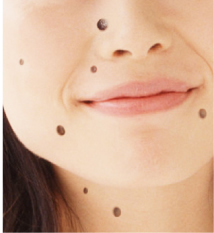


In medical terms, a mole is a pigmented nevus, a type of nevus that appears at or shortly after birth.
They can be found anywhere on the skin, including the face, but depending on the location of the mole, some people may be bothered by its appearance or other reasons.
For larger moles where the laser may leave a crater-like mark, or if the tissue needs to be examined under a microscope, excision is used.
What does Mole removal do?

How moles are removed
There are several ways to remove moles
Circular excision of the mole
Incineration of moles (including laser)
and the choice of treatment depends on the location and size of the mole.
When the location of the mole is not on the face, or the size is more than 5 mm in diameter
Spindle-shaped excision including the mole + stitching
The mole is removed in a spindle shape to include the mole and then stitched with nylon thread. Stitches are usually removed after a week, and a scar will stay slightly longer than the mole after surgery. Please consult with us if you wish to have a more aesthetic procedure for this treatment. (This is not covered by insurance.)
Moles on the face, less than 5 mm in size
Circular excision of the mole
Incineration of moles (including laser)
This is usually done by excising (burning) a round mole at its size and the treatment ends with a puckered skin. After that, as the surrounding skin grows, it will heal to the point where a scar about the size of an acne scar remains.
Flow of Mole Removal
Examination, diagnosis of indication
Topical Anesthesia
Excision and Stitch
Wound Treatment
Skin cancer resembling a mole
After diagnosis, if you are not completely sure if it is a mole or not, it is better to remove it by excision. If the mole is clearly diagnosed as a mole, it can be removed by incineration, but if it is removed, it can be diagnosed by pathological examination using a microscope.
Skin cancer that is very similar to a mole
Although it is not very common to have skin cancer, it is better to have a thorough diagnosis before a removal procedure. The dermoscopy can also be used to give a detailed diagnosis, so it is recommended that you consult a doctor who has been trained in this method before undergoing the procedure.
Basal cell carcinoma
Malignant melanoma
Mole Removal Treatment
Carbon dioxide (CO2) laser
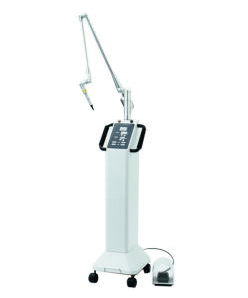
The carbon dioxide laser is a type of infrared laser with a wavelength of 10.6 micrometers, which is longer than visible light. It reacts with water and converts it into heat energy, which destroys and vaporizes the tissue. In the field of dermatology and plastic surgery, it is used to remove moles and warts. Our carbon dioxide laser has three different modes, allowing us to change the depth of laser irradiation in various ways.
I have a 1-cm raised mole above my eye (eyebrow). It is getting bigger and bigger. Is it possible to remove it in one session? How long does it take? How much does it cost? Will I have to wear a bandage after the removal? How long does it take? If I have an incision, I think I will go home with gauze on the day of the procedure. I’m going home by train, so I think it would stand out if it’s too big. Will I have to wear gauze the next day after the surgery? Will it be noticeably large?
On the day of the procedure, a few centimeters of thickly folded gauze will be applied to the area to stop the bleeding, and then fixed with adhesive tape, so please understand that it will be noticeable to some extent. After that, if there is no bleeding, the dressing can be a little smaller, but until the stitches are removed in a week, the wound should be treated and the area should be covered with a small gauze or adhesive bandage to prevent infection. The recommended method may vary depending on your actual condition, so please refer to this as a general guideline. If you come to our clinic once, we will be able to give you more accurate information according to your symptoms, so please make an appointment to see us. In the case of excision, Hiro Skin Clinic accepts your insurance card, so please be sure to bring it with you.
I’m thinking of having a mole removed. I have a large mole on my face, almost 8 mm in diameter, and it is growing up. I’m concerned about scarring on my face.
There are two ways to treat moles: laser scraping and excision with a scalpel, but for your condition, we recommend excision. The laser is a convenient method for small moles, but for large moles that are larger than 4 mm, it often results in a scar that looks like a deep hole the size of the mole, which is not recommended for those who want to make the scar less noticeable. In the case of excision, the scar will be sharp and thin, so although it will leave a slight scar, many people find that it will be almost invisible in the future. In this case, you will be treated at the Hiro Skin Plastic Surgery Clinic in the insurance department. If you are interested, please come for a consultation and discuss with us.
I would like to have a mole removed from my face. It’s a little bit large, but it’s on my face, so I’d like to have it removed by laser. I would like to visit the clinic for a consultation, but is it possible to have the treatment on the spot?
Here, we offer both laser and excision treatments. Depending on the size, location, and color of the mole, there are different limits to which laser treatment will not leave scars. If we think that excision will heal more beautifully, we may recommend that. Laser treatment does not require a lot of waiting, but in the case of excision, if it is on the same day, you may have to wait a little longer, or if it is at night and the appointment is full, you may be accommodated at a later time.
I am thinking of having a mole removed from behind my ear. When the mole is removed, can you put a special tape (adhesive bandage) on the wound? I’ve heard that it can become a crater, and I’m worried about it because I have to tie my hair up. Also, will it take about an hour after the appointment time?
At our clinic, we treat them either by excision with a scalpel or by scraping with a laser. Depending on the location, size, etc., we will discuss through consultation which method will heal more beautifully. In any case, we will take care of the wound, and in the case of laser treatment, we will include the tape and ointment in the treatment fee. If you try to remove a large mole with a laser, there is a high risk of leaving a crater like acne scars or chicken pox scars. In such cases, excision is a better option. The maximum size of the scar that can be removed by laser is 3-4mm. Both excision and laser treatment take about 15 minutes. However, the excision is done in the operating room in between consultations, so you may have to wait for some time. Even so, the procedure can be completed in about an hour.
Regarding mole removal, is it better to have the mole removed in another season, since the UV rays are stronger in summer and I sweat a lot? Is it bad to apply sunscreen or foundation on top of the bandage after the mole removal?
For UV protection after mole treatment, no matter what time of the year you have the treatment, you should always use a strong sunscreen after the tape treatment is completed for at least 6 months until you recover. It doesn’t matter when you get the tape, the rest of the procedure is the same. The most delicate period is during the two-week period when the tape is applied and right after the tape is removed, so if it is the middle of summer or you want to tan at the beach, you might want to move the tape. The plaster will be coated with a medicine that will help the wound heal, and the oil will repel some of the oil, so there is no problem with sunscreen or foundation on the plaster as long as it is applied gently without rubbing.
I have a black mole on my lip that is 4 mm long and 2-3 mm wide. I would like to have it removed, but there are two things I am worried about. One is whether the anesthesia will be injected or applied. I feel uncomfortable about injecting into my lips. Is it possible to use ointment anesthesia? Also, will the scar remain on my lips after the mole is removed, even after the scar heals?
In our clinic, treatment is done either by laser or excision with a scalpel. The lips are a relatively fast healing area, so even if they are slightly larger, laser treatment is often possible, but we will consult with you to determine the best treatment for your needs. All methods require an injection of topical anesthesia. It is the same as anesthesia at the dentist. This is because the ointment anesthesia that is applied does not penetrate deep enough. It is possible to use an ointment anesthesia first to reduce the pain of the anesthetic injection before injecting it. Since the size of the scar is large, it may leave a scar like a crease in the case of excision, or a dent or a slightly lighter color in the case of laser treatment, but in the case of the lips, I think most people will not mind it in the end because it heals quickly and can be hidden with lipstick. If you don’t want to leave a dent from the laser treatment, you can scrape it off in moderation and then re-scrape the part that appeared again.
I have a 5 mm mole under my left eye, can it be removed in a single session?
There are two types of treatment for moles: laser removal and removal with a scalpel. We will guide you to the most suitable method, taking into consideration the location, size, and which will remove the mole more cleanly.
If the mole is near the eyelash line or barely touching the eye, the laser may be easier to remove. However, if a large mole is removed deeply with a laser, it may leave a crater-like scar, so it cannot be removed very precisely. Therefore, if the mole recurs in the future, it may be necessary to remove it again.
In general, small moles up to 3-4mm in size, moles in places where it is difficult to cut and sew with a scalpel, and light-colored moles are often removed with a laser. On the other hand, excision with a scalpel is more suitable when you want to examine the cells under a microscope to see if they are malignant, or when you want to remove a large mole in one session but do not want to leave a crater.
After surgery, avoid heavy exercise, drinking alcohol, and increased blood circulation in order to prevent bleeding and swelling. You will need to visit the clinic multiple times for wound care, follow-up, and stitch removal. Please follow your doctor’s instructions regarding post-treatment wound care, medication, and precautions.