

Injecting Mounjaro takes just three steps: disinfect, unlock, and inject. The procedure itself is not difficult, but choosing the wrong site or storing it incorrectly can make the effects less consistent or make the injection more likely to hurt. In this article, we explain everything from the specific self-injection procedure to storage after you receive it and what to do if you miss a dose, drawing on questions we receive at our clinic and real experiences shared on social media.
Key points firstShort on time? Just read this part
- The basic flow is 3 steps: “disinfect,” “unlock,” and “inject”, and with the dedicated Ateos injection pen you can do it at home without any medical knowledge
- Keep pressing it against your skin for about 10 seconds, as a guide, until you hear the second click
- Mounjaro is a medication that must be kept refrigerated
What you will learn in this article
- What you need for Mounjaro self-injection and how to prepare
- How to choose where to inject, and why you should change the spot each time
- The 3 steps: disinfect, unlock, and inject
- How to store it after you receive it, and the process through to disposal
- What to do if you miss a dose, and how to handle alcohol
First, understand the basic flow of injecting Mounjaro
Mounjaro (generic name: tirzepatide) is a medication you give yourself by injection once a week on a set day of the week. It works by acting on two types of receptors, GIP and GLP-1, and in Japan it is approved as a treatment for type 2 diabetes. The basic flow is 3 steps: “disinfect,” “unlock,” and “inject”, and with the dedicated Ateos injection pen you can do it at home without any medical knowledge.
Even so, quite a few people tense up at the mere word “injection.” In fact, when we looked at what people say on social media, we found many first-time posts saying things like “self-injecting was really scary,” so feeling nervous is nothing unusual. Simply understanding the procedure in advance can greatly reduce your anxiety on the day.
Please note that Mounjaro is prescribed as self-pay treatment (not covered by health insurance), and effects and how you feel vary from person to person. Always follow your doctor’s instructions on dosage and administration.
What you need for self-injection and how to prepare
Before starting self-injection, having three items at hand — the Ateos (injection pen), alcohol swabs, and a disposal container — will help the procedure go smoothly.
You will need the following.
| Item | Purpose |
|---|---|
| Ateos (Mounjaro injection pen) | The medication itself. Keep refrigerated until just before use |
| Alcohol swabs / disinfecting wipes | Disinfecting the injection site |
| Collection bag for used pens | For storing and returning them as medical waste |
| Ice pack (optional) | To cool the site slightly before injecting so you feel less pain |
For people who are very anxious about pain, some clinics use a method of applying an anesthetic patch (such as Penles tape) to the injection site and waiting about 30 minutes before disinfecting. When you receive a prescription at our clinic, please feel free to ask us about pain-relief measures like these.
Once you are prepared, the next stage is deciding where to inject.
Where to inject Mounjaro, and why you should change the spot each time
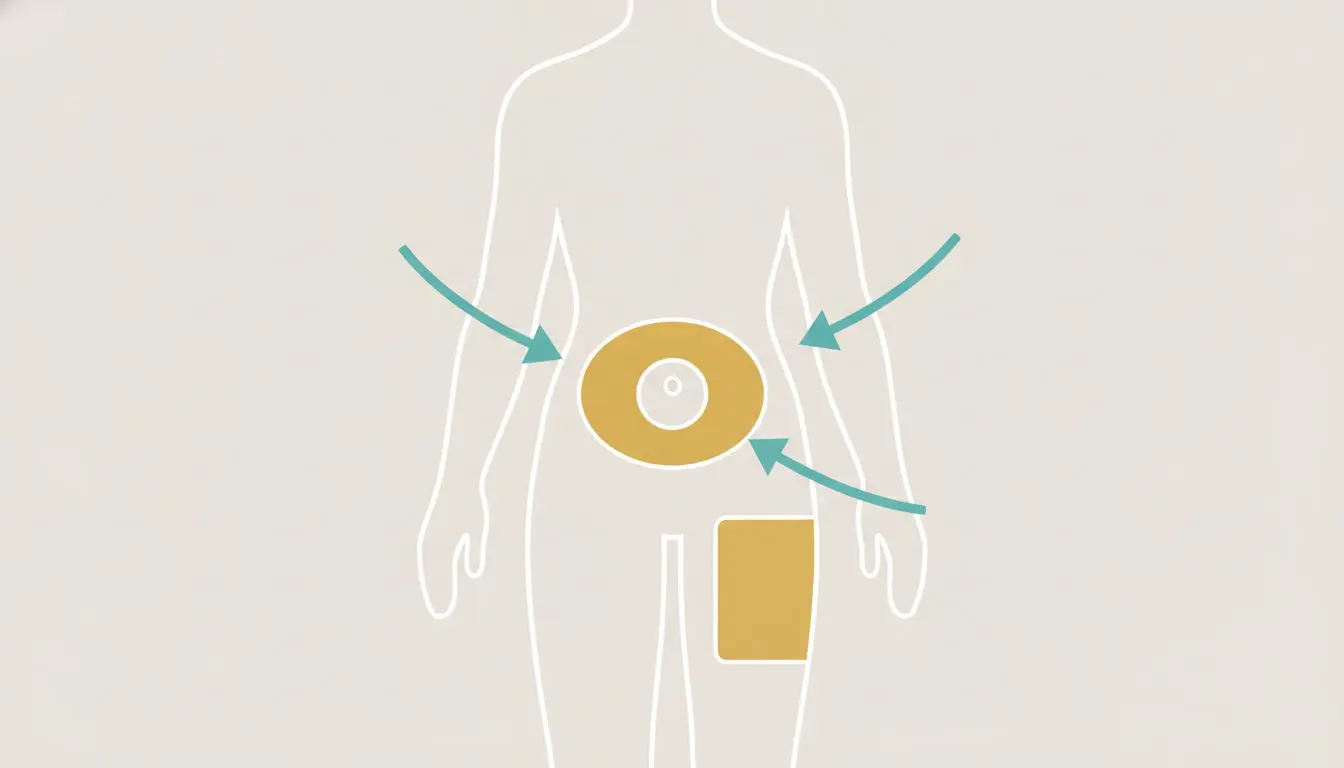
Mounjaro is injected under the skin of the abdomen (avoiding the area around the navel) or the thigh. Rather than always using the same one, it is important to shift the spot slightly each time.
Injecting repeatedly in the same place can make the skin harden or make bruising more likely. Explanatory articles from other clinics also advise avoiding the area around the navel on the abdomen, and the outer side, inner side, groin area, and the area near the knee on the thigh; this is a common precaution across clinics.
Shifting about 2–3 cm from where you last injected, or alternating between the abdomen and thigh, helps spread the strain on your skin. Keeping a note in a memo or your smartphone calendar, such as “last week the right side of the abdomen, this week the left side,” makes it easier to keep track.
While you are still getting used to self-injection, just checking the site each time can feel like a lot. Don’t rush; it is fine to start with a set spot. As you repeat it, rotating sites will naturally become second nature.
3 steps to inject Mounjaro
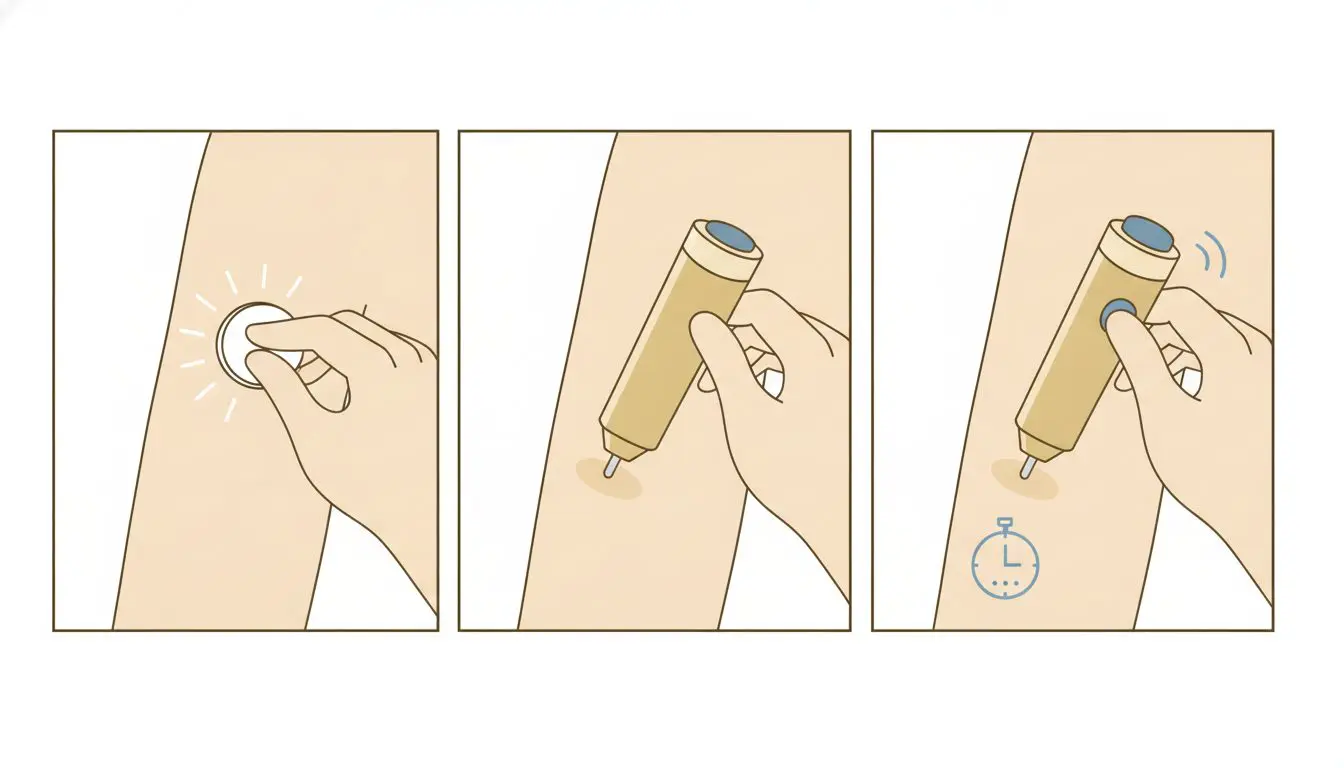
The procedure itself is simple and is completed in 3 steps: remove the cap, unlock, then press the button and wait. Here we explain, step by step, the basic procedure we recommend at our clinic.
Step 1: Disinfect and remove the cap
Thoroughly disinfect the injection site with an alcohol swab, check that it has dried, and then remove the gray cap of the Ateos. If you inject before the disinfectant dries, you may feel a stinging sensation, so we recommend waiting about 10 seconds.
Step 2: Press it against the skin and unlock it
Press the clear base straight against your skin and, keeping it there, unlock it with a twisting motion. Be careful: if you hold it at an angle or pinch the skin hard at this point, the medication may not be injected evenly.
Step 3: Press the injection button and wait 10 seconds
When you press the injection button, you will hear a click and the injection will begin. Keep pressing it against your skin for about 10 seconds, as a guide, until you hear the second click. Once you hear it, simply lift the pen away and you are done.
Until you get used to it, holding it firmly with both hands while pressing can help keep it steady. If you get flustered and lift it away partway through, the full dose may not be injected, so make sure to keep pressing until the end.
Precautions from receiving it to storage and disposal
Mounjaro is a medication that must be kept refrigerated. When picking it up at a pharmacy, bringing an insulated cooler bag gives you peace of mind.
People who have actually been prescribed it say things like, “temperature control is quite strict and it has to be refrigerated, so I brought a cooler bag to pick it up at the pharmacy.” Especially if you will be traveling a long time or picking it up in summer, preparing a bag with ice packs helps maintain its quality.
Used injection pens cannot be thrown out with household waste. The basic process is to put them in a collection bag for medical waste and bring them to the medical institution at your next visit. If you are unsure about handling the needles, please feel free to ask our staff.
One thing to watch out for when storing it in the refrigerator is accidentally forgetting to take it out. On social media, too, there are posts such as “I forgot to take it out of the fridge” and “my Mounjaro doesn’t fit in the fridge,” showing that making space for storage and preventing forgetting are concerns many people face. Getting a dedicated case and making a habit of keeping it in a fixed spot in the refrigerator gives you peace of mind.
Bring a cooler bag, keep it in a fixed spot in a dedicated case, and prepare a disposal bag. Making these three things your rules from the start is the shortest route to avoiding storage problems.
Not sure if it suits you? Start with a consultation.
A doctor decides whether you can use it and which dose is appropriate, based on your consultation and questionnaire.
No consultation fee (first & follow-up visits)Online consultation available
What to do if you miss a dose
If you realize you missed a dose, do not adjust the amount on your own; first consult the clinic that prescribed it.
Mounjaro is designed to be given once a week, and what to do depends on how long it is until your next dose. If it is only a few days late, it is common to inject as soon as you notice and adjust the schedule from then on, but if a long time has passed, a doctor’s judgment is needed.
An effective way to prevent missed doses is to use your smartphone’s reminder function and set a notification for the same day and time every week. It is a good idea to fix it to a time that easily becomes part of your routine, such as “Thursday night.”
Tips for reducing injection pain
The Ateos needle is designed to be extremely thin so that you feel less pain. If pain still bothers you, some people try lightly cooling the area with an ice pack before injecting.
Even if bruising occurs, in most cases it disappears on its own within a few days. However, if swelling or redness lingers or strong pain continues, do not wait and see on your own — consult the clinic early. Specific ways to deal with skin problems are also explained in detail in this article.
How to handle alcohol
You do not need to give up alcohol completely while using Mounjaro. However, reviewing how much and how often you drink is important for managing your health.
In addition to the calories in alcohol itself, eating too many snacks with drinks and the effect on your appetite the next day have also been pointed out. Some people say that they now feel sick more easily when drinking than before, but keep in mind that how people feel varies greatly. Rather than forcing yourself to turn down every social occasion, it is realistic to start with adjustments such as drinking less or drinking more slowly.
Tips for continuing: the idea of “building habits” to prevent rebound
The key to preventing rebound is to use Mounjaro with an eye not only to the period you are using it but also to maintaining your weight after you stop.
Specifically, it is considered effective to build “eating habits that make weight gain less likely” while the medication is working, such as eating vegetables first, leaving carbohydrates until last, and putting down your chopsticks before you feel full. Also, because rapid weight loss can actually lower your metabolism and make rebound more likely, it is recommended to proceed at a reasonable pace, with a guideline of about 3–5% of body weight per month.
Some users say, “It didn’t turn me into someone who doesn’t need to eat — rather, it made me more aware of managing myself,” so it is essential to focus on improving your lifestyle habits rather than relying on the medication’s effects alone.
It is said that many people who maintain their figure feel that “I’m not doing anything special — just a little exercise and a little cutting back on food,” and in fact this “accumulation of small things” is thought to be the essence of building habits. Rather than dramatic efforts, building up small changes you can keep up without strain leads to long-term weight maintenance. For managing your injection schedule, please also see this article.
About self-pay treatment and off-label use
FAQ
QIs it safe to inject Mounjaro myself?
Self-injection is fine as long as you follow the correct procedure under a doctor’s guidance. At your first visit, be sure to receive an explanation of the technique at the clinic and check anything you are unsure about on the spot.
QWhich is better to inject, the abdomen or the thigh?
Either is fine. What matters is not injecting in the same spot repeatedly. Manage this by alternating between the abdomen and thigh, or by changing between left and right.
QIf I miss a dose, is it OK to inject the next day?
What to do depends on the interval, so do not decide on your own — consult the clinic. If it is only a few days, it is common to be advised to inject as soon as you notice.
QI have redness or bruising after the injection. Is that a problem?
Mild redness or bruising often disappears on its own, but if swelling or pain lasts more than a few days, consult your doctor. Detailed ways to deal with skin problems are explained in this article.
QDoes drinking alcohol affect how well it works?
Alcohol itself does not directly interfere with the medicinal action of Mounjaro, but because it affects calorie intake and appetite, it is recommended that you review how much and how often you drink. If you feel unwell, do not push yourself — avoid drinking.
QIs there any way to store it other than in the refrigerator?
Mounjaro should basically be kept refrigerated. For the period and conditions under which it may be kept at room temperature, always check the instructions and package insert provided when it is prescribed, and ask the clinic about anything that is unclear.
QHow much does Mounjaro cost?
It depends on the dose and the prescription period. Because Mounjaro is self-pay treatment, it is not covered by health insurance and you pay the full cost. Specific prices may change, so please check the latest fees on the official price page.
Summary: once you know the correct procedure, self-injection is nothing to fear
Disinfect, unlock, inject. Injecting Mounjaro comes down to just these 3 steps. If you get into the habit of shifting the site, know the rules for storage and disposal, and know who to consult if you miss a dose, daily self-injection is by no means difficult.
If anything worries you, the most important thing is not to decide on your own but to consult the clinic that prescribed it. At our clinic, the first counseling session covers everything from explaining the technique to advice on daily life. You can check fee details on the price page, and for other questions please also see the FAQ page.
If you are interested in medical weight loss with Mounjaro
See our price plans Consult us on LINE
References
For details on the system and the medication, always check primary sources as well.
- Eli Lilly Japan K.K.: How to use Mounjaro®
- Pharmaceuticals and Medical Devices Agency (PMDA), Japan
- Ministry of Health, Labour and Welfare (Japan)
Related articles
Here are articles that will deepen your understanding.
- Mounjaro side effects and what you should know to use it safely
- Skin problems from Mounjaro injections and how to deal with them
- Mounjaro injection dosing plan: a schedule and dose-escalation method for losing weight safely and effectively
If you would like to find the plan that suits you first
Book an online counseling session
*This article is intended to provide general information, and effects and side effects vary from person to person. Mounjaro is a prescription drug provided as self-pay treatment (not covered by health insurance). Always use it under a doctor’s examination and guidance. Personal experiences are for reference only and do not guarantee any medical effect.
Medically reviewed by: Dr. Hiroko Oka (Chair, Fukubikai Medical Corporation / Certified Member, Japanese Society of Internal Medicine)
Who to contact if you have side effects | When to seek care
If any of the following symptoms occur, do not wait and see on your own — contact us. GIP/GLP-1 receptor agonists, including Mounjaro, are known to cause side effects, mainly gastrointestinal symptoms. Most are mild, but in rare cases they can be serious.
| Symptom | Possible cause | What to do |
|---|---|---|
| Persistent nausea or vomiting | Gastrointestinal symptoms; the most common side effect | Contact us if you continue to be unable to keep fluids down |
| Severe abdominal pain (pain that radiates to the back) | Possible acute pancreatitis | Stop the injections immediately and seek medical care |
| Cold sweats, palpitations, intense hunger, or clouded consciousness | Hypoglycemia | Take some sugar right away and contact us |
| Skin rash, difficulty breathing, or swelling of the face or throat | Allergic reaction | Seek medical care immediately |
Contact: 0120-241-929 (hours 9:00–18:00)
If your symptoms are severe outside these hours, please go to your nearest emergency medical facility.
The direct phone numbers for each clinic are listed on the clinic information page.
References
The information on medications in this article is based on the following official materials. For details on dosage and administration and side effects, always check the latest electronic package insert.
Pharmaceuticals and Medical Devices Agency (PMDA), “Mounjaro Subcutaneous Injection Ateos electronic package insert”
PMDA, “Drug Guide for Patients: Mounjaro Subcutaneous Injection Ateos” (PDF)
Ministry of Health, Labour and Welfare, “Prevention of lifestyle-related diseases”
When Mounjaro is used for purposes other than obesity disease, it is self-pay treatment and is not covered by public health insurance. Effects and side effects vary from person to person.

 Free consultation on LINE
