

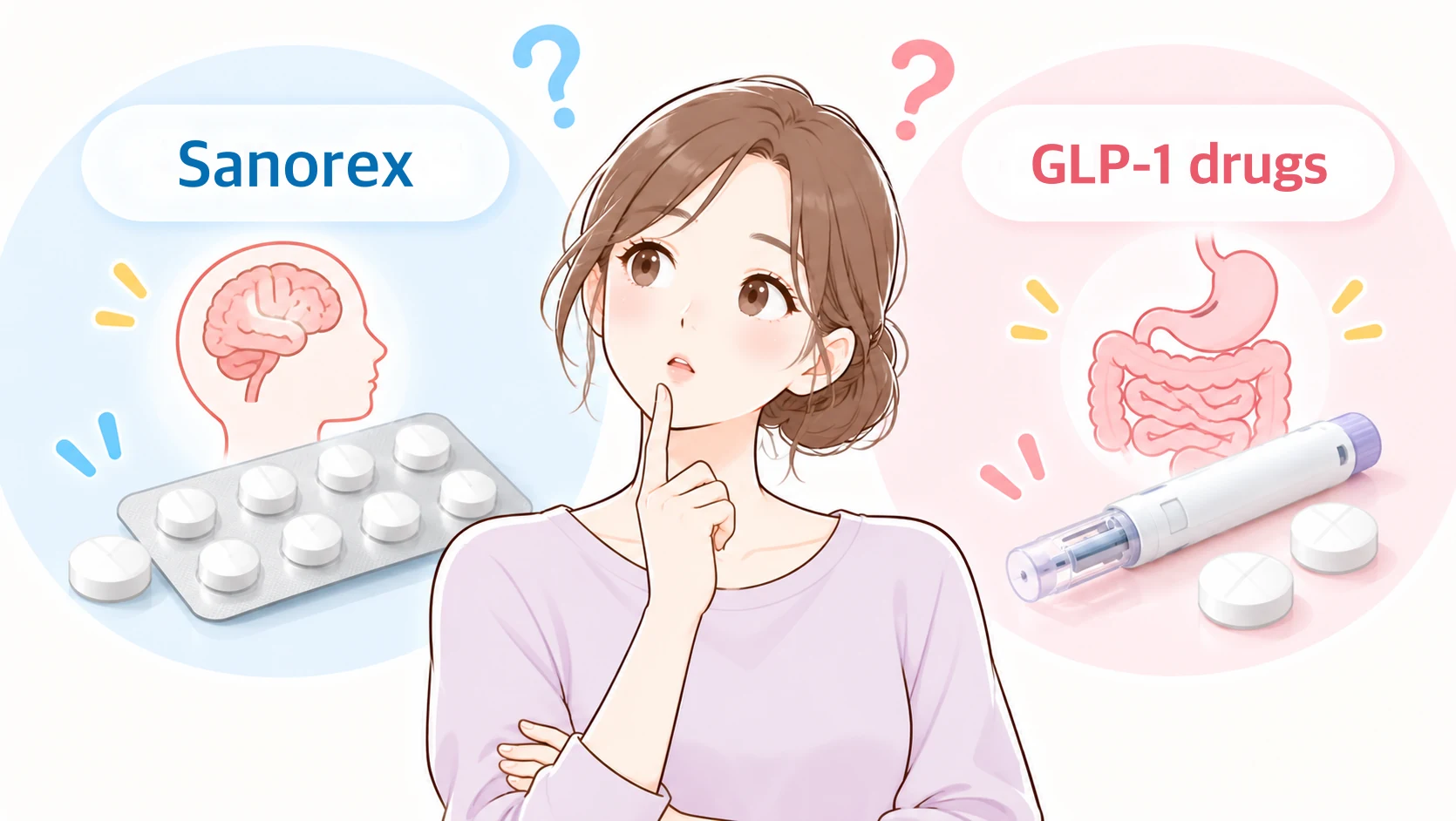
Medical weight-loss drugs fall broadly into two groups: “those that act on the brain to suppress appetite” and “those that use the action of gut hormones.” The main example of the first is Sanorex (mazindol), and examples of the second are Mounjaro and Rybelsus. Although both are “drugs that suppress appetite,” they are completely different in how they work, how long they can be used and whether health insurance can be used. In this article, we set out the information you need to decide between them.
Key points firstShort on time? Just read this
- Sanorex is a drug used for a short, intensive period, while GLP-1 drugs are used to change your eating habits as a whole over a longer time
- Because mazindol acts on the central nervous system, its effect tends to wear off with long-term use, and there are also concerns about dependence
- Sanorex may be covered by health insurance only in cases of severe obesity disease that meet set conditions
What you will learn in this article
- How Sanorex and GLP-1 drugs differ in the way they work
- Why their duration of use differs
- The conditions for Sanorex to be covered by health insurance
- Who each suits and who it does not
- Side effects, and who should avoid them
- What to do after 3 months of use
What kind of drug is Sanorex?
The main ingredient of Sanorex is mazindol, which suppresses appetite by acting directly on the feeding center in the brain’s hypothalamus. It is one of the few anti-obesity drugs approved in Japan for “severe obesity disease”. It has been in use for a long time since its launch, and a characteristic is that people tend to notice reduced appetite within a short period.
On the other hand, it is designated as a psychotropic drug, and its duration of use is limited because of concerns about dependence. It cannot be used in the sense of “it works, so I’ll keep taking it for a long time.” This is the biggest difference from GLP-1 drugs.
Differences from GLP-1 drugs
| Sanorex | Mounjaro / Rybelsus | |
|---|---|---|
| Main ingredient | Mazindol | Tirzepatide / semaglutide |
| How it works | Suppresses appetite by acting directly on the brain’s feeding center | Mimics the action of the gut hormones GLP-1 (and GIP) |
| Form | Oral medication | Injection (once weekly) / oral medication (once daily) |
| Duration of use | As a rule, up to 3 months | No limit (can be used long term) |
| Approval in Japan | Severe obesity disease | Type 2 diabetes |
| Health insurance coverage | Yes, if conditions are met | No (off-label for weight loss) |
| Main side effects | Dry mouth, constipation, dizziness, insomnia | Nausea, constipation, diarrhea |
| Drug classification | Psychotropic drug | — |
The most practical difference is the duration of use. Sanorex is a drug used for a short, intensive period, while GLP-1 drugs are used to change your eating habits as a whole over a longer time.
Why is use limited to 3 months?
Because mazindol acts on the central nervous system, it is said that with long-term use its effect tends to wear off, and there are also concerns about dependence. For this reason, the package insert states that the treatment period is up to 3 months as a rule, and at our clinic we also take a maximum of 3 months of continuous use as our guide.
Three months is only the upper limit; in practice, we prescribe only for as long as needed while checking effects and side effects. Also, because it is designated as a psychotropic drug, a long supply is never prescribed all at once. Please think of it as a drug you continue taking with regular visits and consultations in between.
Conditions for insurance coverage
Sanorex may be covered by health insurance only in cases of severe obesity disease that meet set conditions. Generally, a BMI of 35 or more is the guide, and in addition it is required that diet and exercise therapy have not been effective enough, among other conditions.
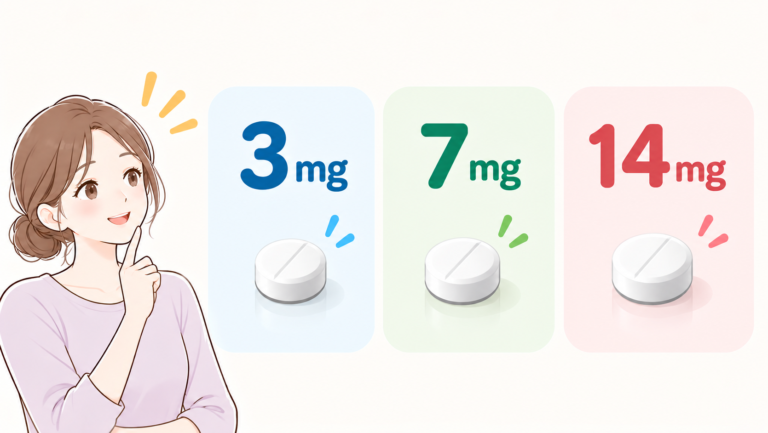
Prescription for people who do not meet the conditions is off-label and self-pay treatment. Whether you meet the conditions is decided at the consultation after checking your BMI, medical history and what you have tried so far. At our clinic, the self-pay price is ¥7,700 (tax incl.) for 14 tablets of 0.5 mg (a 2-week supply).
Not sure if it suits you? Start with a consultation.
A doctor decides whether you can use it and which dose is appropriate, based on your consultation and questionnaire.
No consultation fee (first & follow-up visits)Online consultation available
Who each suits and who it does not
Sanorex may suit you if you
- have a high BMI and want to work on it intensively for a short period
- have a strong appetite and find it hard to eat less
- are reluctant to have injections and want to start with oral medication
- want to see results in the first 3 months to build momentum
GLP-1 drugs may suit you better if you
- feel 3 months is not enough and want to take your time
- are also concerned about your blood sugar or triglycerides
- are prone to insomnia or palpitations
- have glaucoma or a heart condition (because Sanorex cannot be used)
Side effects and when to see a doctor
Side effects reported relatively often with Sanorex include dry mouth, constipation, stomach discomfort, dizziness and insomnia. Many people experience dry mouth, which can be managed by drinking fluids frequently. Taking it in the evening or later tends to cause insomnia, so the timing of doses is adjusted at the consultation.
Rarely, a serious side effect called pulmonary hypertension has been reported. If shortness of breath or palpitations persist, stop taking it immediately and see a doctor.
Who cannot use it
It cannot be prescribed if any of the following apply. Be sure to tell us at your consultation.
- People who are pregnant or breastfeeding
- People with glaucoma
- People with serious heart, liver, kidney or pancreatic disease
- People with cerebrovascular disease
- People with a history of mental illness such as anxiety or depression
- People with a history of drug or alcohol abuse
Not losing muscle determines what happens after you stop
As you lose weight, you lose not only fat but also muscle. When muscle is lost, your basal metabolism drops and your body becomes more prone to weight gain even on the same amount of food. Whether you are likely to regain weight after stopping the drug is largely determined by whether you protected your muscle while losing weight.
When your appetite is reduced, if you do nothing, your protein intake falls along with your total intake. Instead of “I can’t eat, so I won’t,” switch to the idea of shifting what you do eat toward protein.
- Include protein at every meal (meat, fish, eggs, soy products, dairy)
- Since you can eat less, eat the protein first, before carbohydrates or fat
- Keep up light strength training or brisk walking, even just about twice a week
- Don’t add extreme carbohydrate restriction on top. When energy is short, muscle is the first thing to be broken down
If you only follow the number on the scale, you may miss a “failure that looks like success,” where you have only lost muscle. If possible, record your waist measurement along with your weight so you can see what is really changing.
About self-pay treatment and off-label use
FAQ
QCan Sanorex and GLP-1 drugs be used together?
They act in different places, so in theory they don’t overlap, but because their side effects may add up, we do not use them together at our clinic. Which one to use is decided at the consultation.
QWhat happens after 3 months of use?
We stop it for the time being and check whether you are keeping up your eating habits. If needed, one option is to switch to a GLP-1 drug, which has no limit on duration.
QWill my appetite come back when I stop?
Yes, it will. Sanorex is a drug for rebuilding the way you eat while your appetite is suppressed. Whether, during those 3 months, you learn to eat in a way that secures enough protein and how to handle snacking is what makes the difference in results.
QWhen does it start to work?
Many people tend to notice a change in appetite about 1–2 weeks after starting. For details, see What are the effects of Sanorex?
QI’m worried about dependence
If you keep to the period of use and take it under a doctor’s supervision, there is no need to worry excessively. That is exactly why an upper limit on the period has been set and why it is not prescribed in bulk. Avoid obtaining it on your own and using it for a long time.
QCan I drive?
It may cause dizziness or drowsiness. Avoid driving right after you start taking it or while you have symptoms.
QCan I drink alcohol?
Please avoid it. Because it is a drug that acts on the central nervous system, it should not be combined with alcohol.
Not sure? Talk to us
Which drug suits you depends on your constitution, existing conditions, current medications, lifestyle and goals. At our clinic, the consultation fee is free for both first and follow-up visits, and online consultation is available. If you have an existing condition or take other medications, bringing your medication record book (okusuri techo) helps us decide more quickly.
For bookings and enquiries, call our toll-free number 0120-241-929 (free call, 9:00–18:00) or contact us via our official LINE account. You can check our fees on the price list.
*This article is intended to provide general information and does not indicate any individual diagnosis or treatment plan. Using Rybelsus, Mounjaro or metformin for weight loss is off-label use, and medical weight loss is self-pay treatment (you pay the full cost). Whether a drug can be used for you and what dose is appropriate are decided by a doctor after a consultation and questionnaire. Please also see What is medical weight loss?
No consultation fee (first & follow-up visits)Online consultation available
Toll-free 0120-241-929 (toll-free in Japan, 9:00–18:00 JST, Japanese only)



 Free consultation on LINE
