About the cutaneous nerves in the hair transplantation area
この記事の概要
This section describes the sensory nerves innervating the skin of the head. The sensation of the scalp is innervated primarily by three major nerves: the trigeminal nerve (V), the cervical plexus, and the occipital plexus. These nerves branch from the trigeminal (V), cervical plexus, and occipital plexus. Understanding the travel of these nerves, in combination with the use of transduction anesthesia, allows for stable anesthesia.
1. Trigeminal Nerve (CN V)
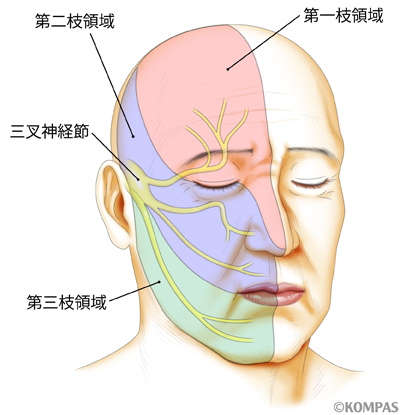
The trigeminal nerve is the main nerve responsible for sensation in the head and has three main branches.
Ophthalmic Nerve (V1) : Innervates the forehead, upper eyelid, dorsum of the nose, and forehead. Specific branches include the frontal nerve (Supraorbital Nerve and Supratrochlear Nerve).
Frontal Nerve : Controls the skin on the forehead and parts of the top of the head.
Maxillary nerve (V2) : Controls sensation in part of the temporal region and the cheek.
Mandibular nerve (V3) : Controls sensation in the lower jaw but does not affect the scalp.
2. Cervical Plexus
The cervical plexus provides sensation to the skin of the neck and parts of the scalp.
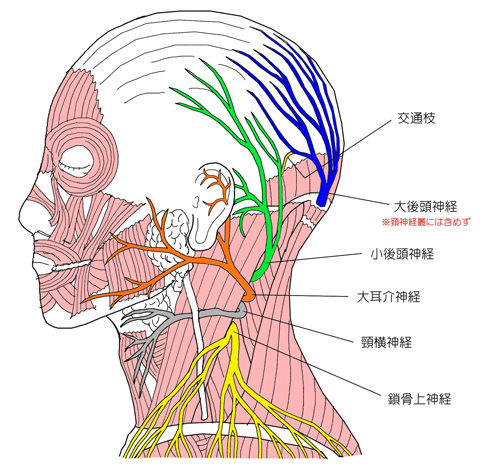
Greater Occipital Nerve (C2) : Innervates the skin at the back of the head and provides sensation to the parietal area, providing a wide range of sensation from the back of the head to the parietal area.
Lesser Occipital Nerve (C2) : Controls the skin behind the ear and on the side of the back of the head.
Great Auricular Nerve (C2-C3) : Provides sensation to the front and bottom of the ear, cheek, and parts of the jaw.
3. Occipital Nerve Plexus
The occipital plexus controls cutaneous sensation at the back of the head.
Third Occipital Nerve (C3) : Innervates the skin of the middle to upper back of the head
summary
The skin of the head is innervated by multiple sensory nerves. These nerves form a complex network, each responsible for sensation in a specific area. Accurate anatomical knowledge is crucial for head surgery and treatment. More information can be found in the following references: