

The ‘overall paternity exclusion rate’ is a measure of the probability of a result indicating that a particular individual is not the biological father of a child. In other words, it indicates how certain the result is that an individual is not the father of a proposed child, e.g. in a DNA test. This indicator is important when assessing the reliability of a paternity test.
This is the probability indicated when the father is determined not to be the father.
The probability of being determined to be the father is the paternity affirmation probability.
The Paternity Exclusion (PE) rate for a single locus is calculated on the basis of the allele frequency (f) at a particular locus. The detailed process of calculation and how to obtain the overall exclusion rate using multiple loci is described below.
Calculation of paternal exclusion rates for one locus.
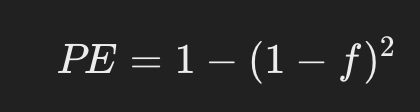
The paternal exclusion rate (PE) at one locus is calculated using the following formula

f = allele frequency (probability of a particular allele being found in a population)
e.g.
Suppose the allele frequency f is 0.2.f = allele frequency (probability of a particular allele being found in a population)
e.g.
Suppose the allele frequency f is 0.2.
The formula applies to:

In this case, the paternal exclusion rate at one locus is 36%.
Calculation of overall exclusion rates for multiple loci combined.
Multiple loci are usually used in DNA testing. The PE calculated at each locus can be combined to obtain an overall exclusion rate. The overall PE at several loci is calculated as follows

PE_i = exclusion rate at each locus
Overall PE = exclusion rate calculated using all loci
e.g.
There are three loci, each with a PE calculated, as follows:
PE_i = exclusion rate at each locus
Overall PE = exclusion rate calculated using all loci
e.g.
There are three loci, each with a PE calculated, as follows:
Locus 1: PE = 0.36
Locus 2: PE = 0.25
Locus 3: PE = 0.40
To calculate this as an overall PE, first calculate (1 – PE) for each locus
1-0.36=0.64,1-0.25=0.75,1-0.40=0.60
Multiply these together:
0.64 x 0.75 x 0.60 = 0.288
Next, calculate the overall PE:0.64 x 0.75 x 0.60 = 0.288
Next, calculate the overall PE:

Overall PE = 1-0.288=0.712
This means that the overall paternal exclusion rate using the three loci is 71.2%.
Key points on paternal exclusion rates
The use of multiple loci improves the accuracy of paternity exclusion.In general, the more loci used, the higher the exclusion rate.
Paternal exclusion rates often reach 99.99% or more, which gives a very high probability of indicating that he is not the father.
Summary
Calculate the paternal exclusion rate using PE = 1 – (1 – f)^2 based on the allele frequency (f) of each locus.
When combining the PEs of several loci, use
to calculate the overall exclusion rate.
Calculating at multiple loci increases the accuracy of excluding paternity.
This method allows DNA testing to determine paternity with a high degree of accuracy.to calculate the overall exclusion rate.
Calculating at multiple loci increases the accuracy of excluding paternity.
This method allows DNA testing to determine paternity with a high degree of accuracy.
Hiro Clinic’s DNA Prenatal Paternity Testing
Hiro Clinic’s DNA Prenatal Paternity Testing (NIPPT) is available at the industry’s lowest price at Hiro Clinic’s directly managed locations nationwide. Testing can be done from the 6th week of pregnancy onward, and the process is completed in a single visit, minimizing inconvenience. If a retest is necessary, it will be conducted free of charge, so you can rest assured. Additionally, tests are conducted at the Tokyo Sanitary Laboratory, which has over 50,000 cases of prenatal testing experience, ensuring reliable results. However, both partners are required to visit the clinic to ensure the most accurate test results. For more information, please check here and make your reservation or inquiry.
略歴
- 1996年 慶應義塾大学医学部 卒業
- 2004年 慶應義塾大学 医学博士号 取得
- 2005年 慶應義塾大学 皮膚科学教室 助手
- 2008年 ヒロ皮フ形成クリニック 開業
- 2009年 医療法人社団福美会 理事長
- 2015年 医療法人社団福美会 理事
資格・所属
- CAPラボディレクター
- 日本皮膚科学会 皮膚科専門医
- 日本医師会 産業医
- 東京衛生検査所 指導監督医
この記事は、 ヒロクリニックNIPPTの編集・監修体制 にもとづき、資格を持つ医師が内容を確認しています。
堤 修一 (つつみ しゅういち)
医師・医学博士 / ヒロクリニック博多駅前院 院長
略歴
- 1993年 東京大学医学部医学科 卒業
- 2016〜2019年 東京大学先端科学技術研究センター 准教授
発信・関連リンク
この記事は、 ヒロクリニックNIPPTの編集・監修体制 にもとづき、資格を持つ医師が内容を確認しています。
参考文献
- Smouse PE, Chakraborty R. The use of restriction fragment length polymorphisms in paternity analysis. Am J Hum Genet. 1986 Jun;38(6):918-39.
- Gjertson DW, Brenner CH, Baur MP, Carracedo A, Guidet F, Luque JA, et al. ISFG: Recommendations on biostatistical evaluation of patterns from post-coital and paternity analysis. Forensic Sci Int. 2007 Nov 1;172(2-3):189-92.
Latest Articles




Supervisor of the article

Dr. Hiroshi Oka
Graduated from Keio University, Faculty of Medicine
Doctor of Medicine
Medical Doctor