
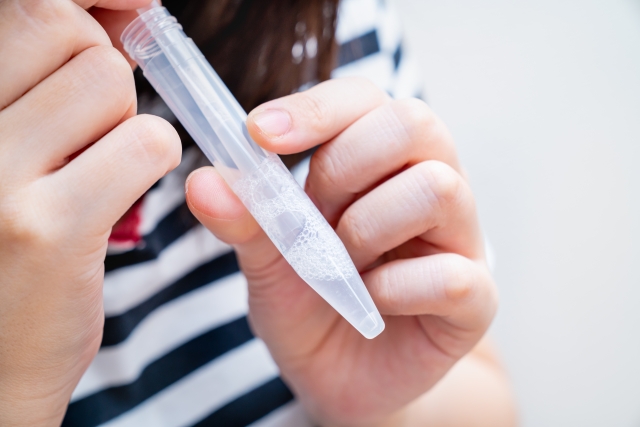
DNA identification using the PCR method (polymerase chain reaction) is a technique used to analyze genetic information by massively amplifying specific portions of DNA. the PCR method is widely used in a variety of fields, including forensic medicine, paternity testing, and disease diagnosis. Below is a detailed explanation of DNA analysis using the PCR method.
What is the PCR method?
PCR (Polymerase Chain Reaction) is a technique that selects specific regions of DNA and amplifies them millions of times in a short period of time in a test tube. The amplified DNA is then easier to analyze and compare, and even very small amounts of DNA samples can be used for identification.
Process of DNA identification using the PCR method
- DNA collection:.
- DNA for identification can come from a variety of body parts, including blood, saliva, hair, and skin tissue, etc. With the PCR method, even a small amount of DNA sample can be analyzed.
- DNA抽出:
- Extract DNA from the collected sample. Destroy the cells to extract the DNA and prepare it for PCR.
- DNA amplification:.
- PCR amplifies specific regions of DNA using a PCR device. the PCR method repeats the following three steps in a cycle
- Denaturation: DNA is heated to break the double helix into single strands.
- Annealing: A short piece of DNA called a primer binds to the specific DNA sequence to be amplified.
- Extension: The enzyme DNA polymerase synthesizes a new DNA strand based on the primer.
- This cycle is repeated many times to exponentially amplify the target DNA region. PCR amplifies specific regions of DNA using a PCR device. the PCR method repeats the following three steps in a cycle Denaturation: DNA is heated to break the double helix into single strands. Annealing: A short piece of DNA called a primer binds to the specific DNA sequence to be amplified. Extension: The enzyme DNA polymerase synthesizes a new DNA strand based on the primer. This cycle is repeated many times to exponentially amplify the target DNA region.
- Analysis of amplified DNA:.
- To analyze the amplified DNA fragments, we usually use techniques such as gel electrophoresis to check the length and pattern of the DNA fragments. This provides a DNA profile that is unique to an individual and can be compared to others.
Main applications of DNA analysis using the PCR method
- Paternity:.
- The PCR method is used to compare the DNA of the child and the parent to determine the parent-child relationship. By checking for a match of specific DNA markers, the parent-child relationship can be determined with a very high degree of accuracy.
- Criminal investigation (forensic):.
- A small sample of DNA (hair, blood, saliva, etc.) left at a crime scene is amplified and matched with a suspect’s DNA to identify the individual.
- Diagnosis of Infectious Diseases:.
- It amplifies viral and bacterial DNA and RNA to rapidly diagnose the presence or absence of infection. The PCR method is also used in the diagnosis of new coronaviruses (COVID-19).
- Genetic Disease Testing:.
- It is used to amplify and confirm the presence or absence of specific genetic mutations associated with genetic diseases.
Advantages of the PCR Method
- Small samples can be tested: DNA samples as small as a few milligrams can be authenticated, allowing analysis of even old materials and debris.
- High sensitivity and specificity: Specific DNA regions can be selected for amplification, enabling accurate detection of the DNA of interest and testing with very high sensitivity.
- Rapid results: The amplification process takes only a few hours to complete, so results can be obtained in a relatively short period of time.
Limitations of PCR method
- Risk of DNA contamination: PCR can amplify even minute amounts of DNA and is very sensitive to contamination or contamination of DNA from outside sources. Careful handling is required during the analysis.
- Selection of the region to be amplified is necessary: Since the DNA region to be amplified is specified with pre-designed primers, it is important to design primers according to the purpose.
Summary
DNA analysis using the PCR method is a technique that can analyze even very small amounts of DNA with high precision, and is used in a variety of fields, including paternity testing, criminal investigations, and diagnosis of infectious diseases. Due to its high sensitivity and specificity, it is widely used as a reliable method for personal identification and proof of genetic relationship.
略歴
- 1996年 慶應義塾大学医学部 卒業
- 2004年 慶應義塾大学 医学博士号 取得
- 2005年 慶應義塾大学 皮膚科学教室 助手
- 2008年 ヒロ皮フ形成クリニック 開業
- 2009年 医療法人社団福美会 理事長
- 2015年 医療法人社団福美会 理事
資格・所属
- CAPラボディレクター
- 日本皮膚科学会 皮膚科専門医
- 日本医師会 産業医
- 東京衛生検査所 指導監督医
この記事は、 ヒロクリニックNIPPTの編集・監修体制 にもとづき、資格を持つ医師が内容を確認しています。
堤 修一 (つつみ しゅういち)
医師・医学博士 / ヒロクリニック博多駅前院 院長
略歴
- 1993年 東京大学医学部医学科 卒業
- 2016〜2019年 東京大学先端科学技術研究センター 准教授
発信・関連リンク
この記事は、 ヒロクリニックNIPPTの編集・監修体制 にもとづき、資格を持つ医師が内容を確認しています。
参考文献
- Jeffreys AJ, Wilson V, Thein SL. Individual-specific 'fingerprints' of human DNA. Nature. 1985;316(6023):76-9.
- Mullis KB, Faloona FA. Specific synthesis of DNA in vitro via a polymerase-catalyzed chain reaction. Methods Enzymol. 1987;155:335-50.
- Butler JM. Genetics and genomics of core STR loci used in forensic DNA databases. Forensic Sci Int Genet. 2006;1(1):3-19.
Latest Articles




Supervisor of the article

Dr. Hiroshi Oka
Graduated from Keio University, Faculty of Medicine
Doctor of Medicine
Medical Doctor