



Skin
Beauty
“DNA Skin Beauty” for beautiful skin

The genetic test “DNA Skin Beauty” for beautiful skin measures will tell you the type of skin you were born with. If you know your tendencies, you can learn about skin care methods and measures, as well as your dietary style. The genetic test for beautiful skin measures will provide you with beauty information that will help you with your daily skin care and lifestyle habits that are tailored to your skin.

fast, cheap, and highly accurate!
detailed reports
Testing for Beautiful Skin
“DNA Skin Beauty” for beautiful skin
and 6 Types of SNPs

In addition to the three general genes, we will also add three genes that are important for beautiful skin, for a total of six SNPs (MMP1 gene, ASIP gene, GPX-1 gene, GCLM gene, FLG gene 1, FLG gene 2) to test and analyze.
This will allow you to learn more about your skin type and find the optimal skin care measures.
Among the genes that play the role of this “biological blueprint,” there are some that are said to be particularly related to beautiful skin/beauty. These include “genes related to the ability to break down collagen,” “genes related to the ability to withstand external influences such as ultraviolet rays,” and “genes related to the ability to break down antioxidants.”
By examining these genes, mutations in genes that control enzymes related to the four major signs of aging: wrinkles, sagging, age spots, and dry/sensitive skin can be examined. Risk assessment is performed to determine whether or not the skin type is prone to developing wrinkles, sagging , age spots, and dry/sensitive skin.
By finding out the risks to your skin (wrinkles / sagging, spots, dry skin/sensitive skin), and taking appropriate measures to treat your skin, it is quicker, cheaper, easier, and more effective to eliminate the risks by following your body’s blueprint, rather than administering medicine or applying a compress to treat it after a problem occurs
By finding out your genes, which are the blueprint for your body, and finding out your skin type, you can get a concrete idea of what you need in terms of beautiful skin/beauty. This will greatly increase the chances of you being able to choose high-quality skin care methods and cosmetics that are appropriate for you, and you will be able to achieve the skin of your dreams.

MMP1 gene
Collagen is necessary to maintain beautiful skin, and the gene that breaks down this collagen is the MMP1 gene. This MMP1 gene is inherited from parent to child, and if the MMP1 gene is highly active, it directly affects skin aging. Therefore, we test what type of MMP1 gene you have and whether it is highly active or not.

ASIP gene
The ASIP gene is an agouti signaling protein (ASIP) gene that acts on the melanocortin 1 receptor, which regulates melanin synthesis in melanocytes in the skin. ASIP is involved in determining skin color, and it is said that if there is a mutation, people tend to be more sensitive to ultraviolet rays and are more likely to develop spots.

GPx-1 gene
The GPx-1 gene is involved in the activation of glutathione peroxidase 1 (GPx-1), an enzyme that removes hydrogen peroxide. If the activity of GPx-1 is lower than normal, the body’s ability to remove hydrogen peroxide produced in the body decreases, and melanocytes tend to be stimulated by hydrogen peroxide, making spots more likely to form.
GCLM gene
The GCLM gene is the glutamate cysteine ligase modifying subunit (GCLM) gene, which is involved in the synthesis of the antioxidant glutathione. If the amount of GCLM is lower than normal, the ability to synthesize glutathione decreases, and the ability to remove active oxygen decreases. As a result, wrinkles and age spots tend to appear more easily.

FLG gene 1
One of the most important functions of the skin is its barrier function. If the barrier function from the inside to the outside of the skin is weak, the amount of water evaporating from the skin surface increases, making the skin more susceptible to dryness. The FLG gene has a major impact on this function.

FLG gene 2
People who do not have enough natural moisturizing factors (NMF) that moisturize the skin tend to have dry or sensitive skin. The FLG gene is an NMF and is the gene for the protein filaggrin (FLG), which is important in the formation of the stratum corneum. If there is a mutation in the FLG gene, the amount of FLG is less than normal, the skin’s barrier function is weakened, and the skin tends to become dry or sensitive.
By conducting detailed testing of these five genes and six types of SNPs at our own DNA laboratory in Japan, we are able to provide our customers with “highly accurate test results that are tailored to each individual” at “low cost and quickly” that will satisfy them.


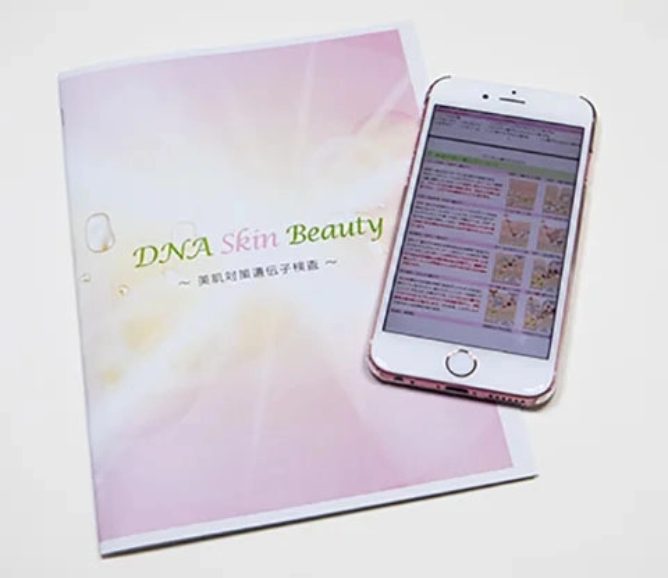
>A full-color report of about 60 pages will be provided in PDF format
It contains important information on the “prevention and improvement” of skin aging and skin stress. “What ingredients and foods are good for my skin?” “What should I pay attention to in my daily skin care?” If you are concerned about your skin but are unsure of what to do, we will introduce effective measures for beautiful skin. We hope that by choosing cosmetics and intentionally incorporating beauty ingredients into your daily meals, you will be able to take effective measures for beautiful skin that are suited to your skin type
A full-color report of about 60 pages
will be provided in PDF format

Application – Reporting Process

Application and payment

Test kit arrives, and DNA is collected

Return

Report

Skincare technology and products are evolving day by day, and new cosmetics are being released one after another. This is probably because there is such a high demand and people are interested in it. We understand that skincare is important, but why do the results not always match even if you use the same skincare method or cosmetics?
We are genetic experts, so let me explain genes. I think many people know that each person’s genotype is different and each person’s constitution is different. Using this, there is a field called tailored medicine. Tailored medicine is the medical treatment that is tailored to each individual’s constitution.
The big difference between ready-made clothes and tailored clothes is that ready-made clothes are simply “clothes made for the average majority of people,” while tailored clothes are “clothes for a specific individual based on the individual’s characteristic information.” Until now, medical care and medicine have been average medical care and medicine that targets the “average majority,” and current treatment means that if the disease or symptoms are the same, the same treatment and the same medicine are used for everyone.
Tailor-made medicine involves examining an individual’s genetic information, understanding their constitution and the state of their illness, and then prescribing and administering medication that will definitely be effective for that individual. With regard to medication in particular, it has become clear that a person’s metabolic function for a certain drug can vary greatly depending on their genotype, and that even if the same amount is administered, the effectiveness of the drug can vary. It has also become clear that the side effects of a drug can vary depending on the genotype.
Current skincare methods and cosmetics are similar to the medical world, relying on success stories? Aren’t skincare methods and cosmetics that target the “average majority” popular? Isn’t it similar to old-fashioned medical care, where only those who believe that “disease comes from the mind” are saved? The reason why results are not uniform when using the same skincare method or cosmetics is that there are 100 different human genes for 100 people, and everyone is different.
If you can understand a person’s genetic nature (skin type), you can realize that you cannot use the same skincare method or cosmetics as others. Then, you will have an extremely high chance of choosing high-quality skincare methods and cosmetics that suit (suit) that person.
-iGENO DNA Skin Beauty-


 Toll-free