

Many pregnant women struggle to fall asleep or wake up repeatedly during the night. The causes go beyond hormonal shifts and a growing belly — they also change depending on the stage of pregnancy. This article walks through why the Sims position (lying on the left side) is considered the safest way to sleep, how to choose and arrange bedding, trimester-by-trimester tips for better sleep, and the signs that mean it’s time to see a doctor.
💡 What You’ll Learn in This Article
- The main reasons sleep gets harder during pregnancy, and how they change by trimester
- Why the “Sims position” (lying on the left side) is considered the safest way to sleep
- What to look for when choosing a body pillow and mattress
- Step-by-step guidance for arranging cushions to support your posture
- Sleep tips for early, mid, and late pregnancy
- Signs that mean ongoing sleep trouble is worth discussing with a doctor
Main Causes of Sleep Trouble During Pregnancy
Sleep trouble during pregnancy usually comes from hormonal changes and physical discomfort layered on top of each other. It’s rarely just one cause — most women are dealing with several factors at once.
- Hormonal changes
Rising levels of progesterone tend to increase drowsiness during the day while making nighttime sleep lighter and easier to interrupt. - Physical discomfort
As the belly grows, sleeping on your back or stomach becomes harder, and back pain, swelling, and leg cramps can all disrupt sleep. - Frequent urination and acid reflux
The growing uterus presses on the bladder, leading to frequent bathroom trips, and pressure on the stomach can bring on acid reflux. - Mental stress
Anxiety about childbirth and parenting, as well as the tension of waiting for results from tests like NIPT (non-invasive prenatal testing), can also get in the way of restful sleep.
In late pregnancy, many women also deal with restless legs syndrome on top of everything else. Discomfort in the legs can flare up the moment you lie down, making it hard to drift off — something we hear about often from patients. One pregnant X (Twitter) user, @3ti_qt, described it well: exhausted from work and desperate to sleep, only to be kept awake by uncomfortable sensations in her legs the moment she got into bed. Daytime fatigue colliding with nighttime leg discomfort seems to be a shared struggle for many pregnant women.
Sleep deprivation during pregnancy doesn’t just affect the mother. Ongoing short sleep can reduce blood flow to the placenta, which may affect fetal growth. Research from overseas has found that women who sleep less during pregnancy are more likely to give birth to babies weighing less than 2,500 grams (about 5.5 lb). That’s exactly why understanding the causes — and addressing them early with the right approach — matters.
Safe Sleep Positions: Why the Sims Position (Left Side) Is Recommended
From mid-pregnancy onward, sleeping in the “Sims position” — lying on your left side — is considered the standard, safest posture. The reason is straightforward: once the belly grows large, lying flat on your back lets the uterus press against major blood vessels running near the spine, including the inferior vena cava and aorta.
Staying on your back for extended periods can lead to the following changes.
- Reduced blood flow reaching the baby
- Dizziness or shortness of breath in the mother (supine hypotensive syndrome)
- Increased swelling and lower back strain
Lying on the left side keeps the uterus from compressing the major blood vessels as much, which helps maintain blood flow to the uterus and placenta. Sleeping on your right side won’t stop you from sleeping, but circulation is thought to be slightly less efficient than on the left. If the right side feels more comfortable, it’s not a problem — just try to favor the left as your default.
That said, in early and mid-pregnancy, when the belly hasn’t grown much yet, there’s no need to be overly strict about sleeping position. It’s completely normal to shift positions during sleep. If you wake up on your back, there’s no need to panic — simply roll back onto your side.
Tips for Choosing Bedding for Pregnant Women
Comfortably maintaining the Sims position starts with the right bedding. Take a fresh look at your body pillow, mattress, and sheet material.
1. A Maternity-Specific Body Pillow
A pillow designed for pregnancy supports your belly and lower back while you sleep on your side, helping you hold a stable position. With a body pillow in the Sims position, you don’t have to think about where to put your arms and legs, which makes it much easier to stay on your left side naturally.
Even with a body pillow, keeping a consistent sleep position can still be a challenge. @ririi731 shared on X that she used her body pillow to shift positions during pregnancy while making sure her older child didn’t kick her belly. For households with an older sibling in the bed, a body pillow can double as a protective barrier for the belly. Even sleeping alone, it’s worth using one simply to help keep your posture stable.
2. Mattress Firmness
A mattress that’s too firm strains the back and lower back, while one that’s too soft lets your body sink in and can make breathing harder. A high-resilience mattress with moderate firmness is a good choice for pregnancy.
3. Breathability and Cleanliness
Body temperature tends to run higher during pregnancy, so it’s worth choosing materials that absorb and release moisture well. Organic cotton and bamboo-fiber sheets are gentle on the skin and comfortable even during the months when you’re more prone to sweating.
If you’d like to take a closer look at bedding options and compare sleep aids more broadly, our companion article on sleep aid ideas for pregnant women is worth a look. From here, let’s get into exactly how to use that bedding to build a comfortable sleep position.
Adjusting Your Sleep Posture for Comfort
Now let’s look at exactly how to use your bedding to build a comfortable position. We’ll cover the base posture first, then how to use pillows effectively.
1. Start With the Sims Position
The “Sims position” means lying on your side with your left side down. Many women find this the most comfortable position once the belly grows large in late pregnancy.
This position offers several benefits.
- Less pressure on the belly and lower back, so the body feels more at ease
- Major blood vessels (like the inferior vena cava) are less compressed, helping maintain blood flow to both mother and baby
- Leg swelling and heaviness tend to ease as well
Here’s how the Sims position compares with lying on your back, right side, or stomach.
| Sleep Position | Status in Late Pregnancy | Things to Watch For |
|---|---|---|
| On the back | Vena cava is easily compressed | Switch to your side if you feel dizzy or short of breath |
| Left side down (Sims position) | Blood flow is well maintained | Recommended as the base position |
| Right side down | Still allows sleep | Circulation is thought to be slightly less efficient than on the left |
| On the stomach | Physically difficult once the belly grows | Best avoided in late pregnancy |
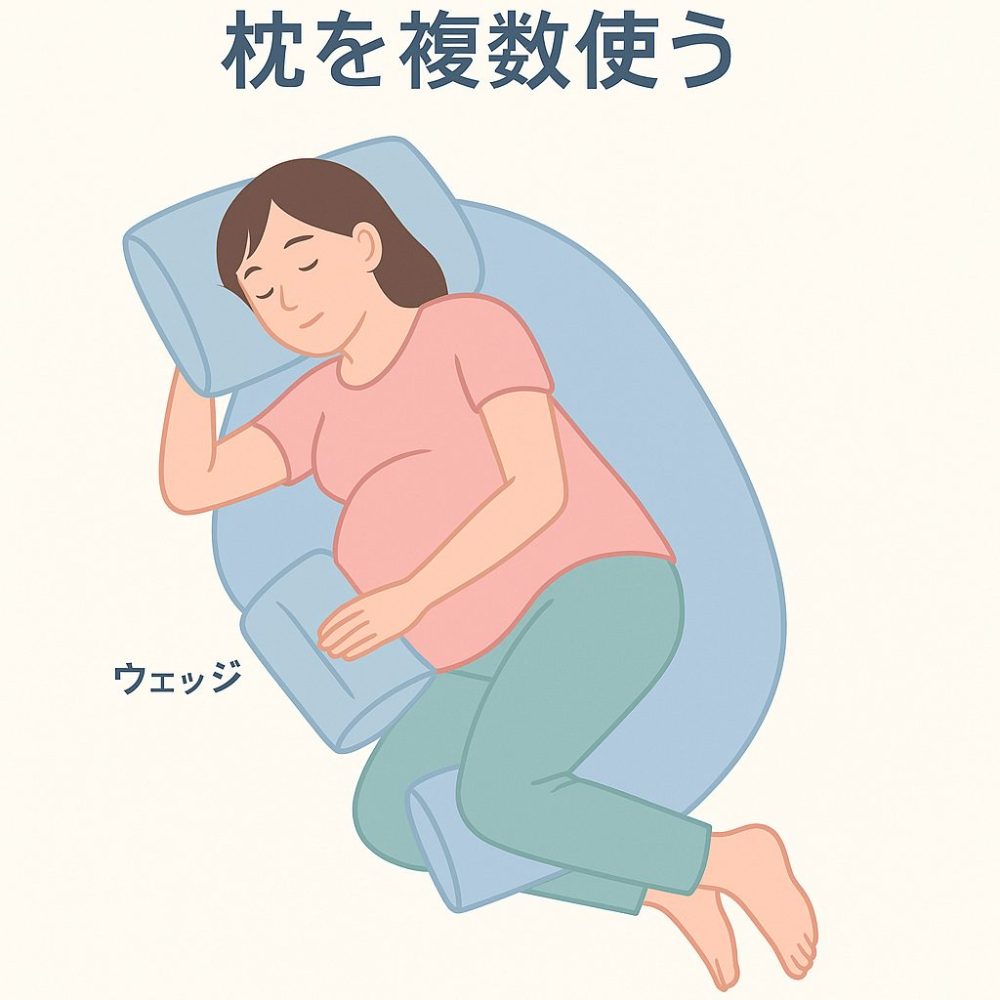
2. Use Multiple Pillows
Beyond a head pillow, tucking cushions under your back, under your belly, and between your knees adds extra stability.
The Basic Setup (Start With These 5 Items)
- Head pillow: high enough that your neck stays straight while lying on your side (roughly 8–12 cm / 3–4.5 in).
- Long body pillow: close to your own height (120–160 cm / 47–63 in) works well. C-shaped, U-shaped, or I-shaped all work.
- Knee cushion: thick enough to keep your thighs, knees, and ankles in a straight line (roughly 10–15 cm / 4–6 in).
- Belly wedge: a triangular cushion to support the weight of your belly (7–12 cm / 2.75–4.5 in thick).
- Back stopper: a thin cushion or rolled towel placed behind you to make it harder to roll onto your back in your sleep.
Placement Steps (Left-Side Sims Position)
Just placing your cushions in this order makes it much easier to settle into a stable position without forcing it. Try each step in turn.
- Keep your head and neck straight
Rest your head on the pillow while lying on your side, and adjust the height until your ear and shoulder line up. There should be no crease at the side of your neck. - Hug the body pillow from chest to knees
Wrap your upper arm and leg loosely around the body pillow. This reduces pressure on the shoulder and helps stabilize the pelvis. - Place a cushion between your knees
Align not just the thighs but the knees and ankles as well, at the same height. This reduces strain on the pubic bone and pelvis. - Slide a wedge under your belly
Gently tuck it under your belly so it’s supported without sinking. Don’t pack it in too tightly, or it can create pressure instead of relief. - Add a stopper behind your back
Place it a little away from your spine at an angle that makes it harder to roll onto your back without noticing.
The trick is to place your cushions in this order: head → body pillow → knees → belly → back. Finish by gently shaking out your whole body and settling into the position where you feel the least tension.
3. Managing Leg Swelling
Placing a towel or small cushion under your feet to elevate them slightly can improve circulation and help prevent swelling and leg cramps. If you’re on your feet a lot during the day, this small adjustment at bedtime can make a real difference in how your legs feel the next morning.
Sleep Tips by Trimester: Early, Mid, and Late Pregnancy
The causes of sleep trouble — and how to address them — shift depending on where you are in pregnancy. Use the table below to see which stage matches where you are now.
| Stage | Main Reasons for Sleep Trouble | What to Try |
|---|---|---|
| Early pregnancy (up to around week 15) | Morning sickness, rapid hormonal shifts, anxiety | Prioritize whatever side position feels comfortable. No need to force a fixed sleep position yet |
| Mid-pregnancy (around weeks 16–27) | Relatively stable, but nighttime bathroom trips start increasing | Adjust fluid intake before bed, and start getting used to the Sims position with a body pillow |
| Late pregnancy (from around week 28) | Belly weight, frequent urination, leg cramps, restless legs syndrome | Use a full cushion setup to hold the Sims position, and elevate your feet |
In early pregnancy, sleep trouble often has less to do with position and more to do with morning sickness and emotional ups and downs. If you feel your mood swings are affecting your sleep, our article on coping with emotional ups and downs during pregnancy may help.
The later pregnancy progresses, the more your sleep quality depends on posture itself. Try following the cushion placement steps above consistently for about three days to let your body adjust.
▼ Want to talk about your health during pregnancy, or about NIPT?
When Persistent Sleep Trouble Means It’s Time to See a Doctor
If adjusting your sleep position doesn’t help, or if you notice any of the signs below, don’t just try to push through it — talk to your OB-GYN.
- Strong shortness of breath or heart palpitations that wake you repeatedly during the night
- Sudden swelling of the legs or face, along with headache or blurred vision
- Regular tightening of the belly that’s noticeable enough to keep you awake
- Sleep trouble that’s lasted more than two weeks and is starting to affect daily life
- Ongoing low mood or strong anxiety, along with changes in appetite or being more prone to tears
In our clinic, we’ve seen cases where a patient assumed she “just wasn’t sleeping well” when swelling or blood pressure changes were actually involved. Swelling and heart palpitations can sometimes signal conditions like pregnancy-induced hypertension that need prompt attention. Rather than assuming it’s simple sleep deprivation, it’s best to bring up any symptoms that concern you rather than waiting for your next scheduled checkup. For a more detailed look at symptoms to watch for by condition, see our article on common pregnancy conditions and how to respond early.
If you’d like to dig deeper into the causes of sleep trouble and how to think about sleep aids, our article on solving sleep trouble during pregnancy is also worth reading.
The Relationship Between NIPT and Sleep
NIPT (non-invasive prenatal testing) screens for the possibility of fetal chromosomal differences using only a maternal blood draw — it is a non-definitive screening test, not a diagnosis. The days spent waiting for results are, for many women, a time when anxiety and tension can lead to poor sleep.
- Before the test: try to get enough sleep so your body is in good condition for the blood draw.
- After the test: stress while waiting for results can easily disrupt sleep, so relaxation techniques such as aromatherapy, music, or breathing exercises can help you settle down.
It’s also worth remembering that NIPT only indicates a probability — it is a non-definitive test. If the result is positive, amniocentesis is required for a definitive diagnosis. Understanding exactly what the test does and doesn’t tell you can itself help ease anxiety while you wait for your results.
Lifestyle Habits That Support Sleep
Sleep position isn’t the only thing that matters — how you spend the time before bed directly affects sleep quality too. Here are three habits you can start today.
- A bedtime routine
Light stretching, a bath, or a warm caffeine-free drink helps activate your parasympathetic nervous system, making it easier to fall asleep. - Limiting phone and computer use
Blue light suppresses melatonin, the hormone that regulates sleep, so it’s best to put screens away starting about an hour before bed. - Moderate exercise
Prenatal yoga and walking improve circulation and can enhance the quality of your sleep at night — just be sure to get your doctor’s approval first. For specific exercises and stretches, see our article on safe exercise and stretching during pregnancy.
If you’d like to review how you’re spending late pregnancy more broadly, our article on what to keep in mind during late pregnancy is a helpful companion piece. Adjusting how you spend your days can support better sleep at night, too.
▼ Want to talk about sleep worries or your overall health?
Frequently Asked Questions (FAQ)
Here are answers to questions we’re often asked in clinic about sleep positions during pregnancy.
Is it okay to sleep in a position other than the Sims position?
Yes, that’s fine. The Sims position is just the general guideline. If it doesn’t cause discomfort, sleeping on your right side is also fine. The one thing to avoid is staying flat on your back for long periods.
I woke up and realized I was on my back. Will this affect my baby?
A short time on your back rarely causes any meaningful effect. Simply rolling back onto your side once you notice is enough, so there’s no need to worry excessively. If you feel dizzy or short of breath, change position right away.
When should I start using a body pillow?
Many women start once they begin feeling their belly tighten, around mid-pregnancy. Getting used to it early means the side-lying position will already feel natural by the time your belly grows larger in late pregnancy.
Do I need to be careful about position during naps too?
For short naps, there’s no need to be overly strict about it. However, if you’re napping for more than 30 minutes in late pregnancy, it’s worth favoring the left side, just as you would at night.
If I keep having trouble sleeping, how long should I wait before seeing a doctor?
As a general guideline, if sleep trouble hasn’t improved after two weeks of trying different approaches, or if it’s affecting your daily life, it’s worth seeing a doctor. If you notice other symptoms like swelling or palpitations, reach out promptly regardless of how long it’s been.
Is sleeping on my right side really off-limits?
Not at all. The left side is thought to be somewhat more efficient for blood flow, but sleeping on the right side doesn’t prevent sleep. Use whichever position feels comfortable as your base, while trying to work the left side in when you can.
Conclusion
Comfortable sleep during pregnancy is directly tied to the health of both mother and baby. Improving your bedding and sleep posture can significantly improve sleep quality throughout pregnancy. Getting enough rest also supports stress management and overall condition around the time of tests like NIPT.
One step you can take starting tonight: place your cushions in the order head → body pillow → knees → belly → back before you lie down. To make the most of this precious time before your baby arrives, take some time now to find the bedding and habits that work for you. If sleep trouble continues or comes with symptoms that concern you, don’t just make assumptions — talk with your OB-GYN.
Medical Supervision: Hiroshi Oka, M.D., Ph.D. — Director-General and Lab Director, Hiro Clinic (Medical Corporation Fukubikai). Graduate of Keio University School of Medicine. Passed medical licensing examinations in both Japan and the United States, and holds a Ph.D. in Medicine. One of a limited number of certified Lab Directors in Japan. Author of “The First Book to Read When You Find Out You’re Pregnant” (Japanese title). This article was written in accordance with medical advertising guidelines, referencing information from public institutions and academic societies. The sleep positions and habits described are general guidance only; individual circumstances during pregnancy vary. Always confirm with your own OB-GYN before trying any of the suggestions here.
References:
- Japan Society of Obstetrics and Gynecology
- ACOG, “Sleep During Pregnancy”
- Japan’s Children and Families Agency, “Maternal and Child Health”
- National Center for Child Health and Development, “Pregnancy and Childbirth”
日本皮膚科学会 皮膚科専門医/日本医師会 産業医/東京衛生検査所 指導監督医
この記事は、 ヒロクリニックNIPTの編集・監修体制 にもとづき、資格を持つ医師が内容を確認しています。