

The fetal ultrasound marker test (NT scan) is a screening test performed between 11 weeks 0 days and 13 weeks 6 days of pregnancy, checking the thickness of the fluid-filled space at the back of the baby’s neck (nuchal translucency, or NT) to estimate the likelihood of a chromosomal abnormality. A thicker-than-average NT does not confirm a diagnosis such as Down syndrome by itself. It is only a screening measurement that indicates a “higher likelihood,” and a confirmatory test such as chorionic villus sampling or amniocentesis is required to reach a definitive diagnosis.
💡 What this article covers
- What the fetal ultrasound marker test (NT scan) checks and when you can have it
- How the NT cutoff value is set, and what to know if you’re told your NT is “thick”
- Other ultrasound markers checked alongside NT (nasal bone, ductus venosus flow, tricuspid regurgitation)
- The next steps available if your result is above the cutoff (NIPT, amniocentesis)
- Typical costs, and how this test differs from a fetal anomaly scan and NIPT
What Is the Fetal Ultrasound Marker Test (NT Scan)?
This test checks for ultrasound findings that are more often associated with a chromosomal abnormality. The finding itself is not a disease.
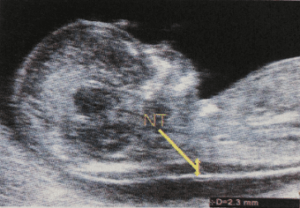
Checking a baby’s shape and structure by ultrasound has become a routine part of prenatal care. An ultrasound finding that appears more often in babies with a chromosomal abnormality is called an “ultrasound marker.” The best-known marker is the subcutaneous fluid seen at the back of the baby’s neck, known as nuchal translucency, or NT. NT is a normal physiological finding that can appear even in healthy babies, so it needs to be considered separately from a structural abnormality. Babies with Down syndrome (trisomy 21) have been reported to more often show a thicker NT in early pregnancy.
In my own outpatient consultations, I’m often struck by how many expectant parents become anxious simply because the term “NT” takes on a life of its own. Understanding what the number actually means is usually the fastest way to ease that worry.
When Can You Have the Test, and What Happens on the Day?
The NT scan can only be performed between 11 weeks 0 days and 13 weeks 6 days of pregnancy.
During this window the baby’s crown-rump length (the measurement from head to bottom) is roughly 45 to 84 mm, which is the only stage at which NT can be measured accurately. Once this window has passed, NT can no longer be evaluated, so if you’d like the test, it’s best to speak with your obstetrician early.
The scan is usually carried out as part of a routine prenatal ultrasound, using a mid-sagittal view (a side-on view of the baby) to measure the thickness at the back of the neck. It requires no special preparation, causes no pain, and places almost no burden on the mother. Most obstetric clinics will perform it if you simply mention that you’d like screening for a chromosomal abnormality.
What Is the NT Cutoff Value, and How Should You Read the Number?
There is no single nationwide pass line for NT; the reading is assessed against the distribution expected for that stage of pregnancy (crown-rump length).
As a general guide, an NT above roughly 3.0 mm is often flagged for further assessment, though some facilities use a threshold closer to 3.5 mm, and the exact figure varies across the medical literature. The thicker the measurement, the higher the tendency toward risks such as a chromosomal abnormality or congenital heart condition, but plenty of babies with a thicker NT are born perfectly healthy. It’s also worth remembering that an NT within the normal range does not rule out a chromosomal abnormality entirely.
| NT measurement | How it’s generally interpreted |
|---|---|
| Under 3.0 mm | Considered “within the normal range” at most facilities |
| Around 3.0–3.5 mm | Some facilities may recommend further testing (such as NIPT) |
| Above that | Tendency toward higher risk of chromosomal abnormality or heart condition; further testing is usually considered |
Why an NT Above the Cutoff Doesn’t Mean Down Syndrome
A thickened NT is a “flag for further checking,” not a diagnosis in itself.
NT thickening in early pregnancy is often a temporary finding: it can become less noticeable, or even disappear, as the pregnancy progresses. Even when thickening is present, it isn’t always linked to a chromosomal abnormality — sometimes it points to a congenital heart or skeletal condition, and sometimes it’s simply individual variation with no underlying condition at all. Rather than dwelling on the number alone, it helps to work through the next steps together with your doctor.
On X, I’ve seen posts from parents who were told their NT was on the thicker side during an early anomaly scan. @kiimama45 wrote that their NT was “a little on the thick side, but just above the normal range — not really something to worry about, but we were told to talk it over,” and that they’d booked NIPT counseling for the following week. Getting a borderline reading and then working out the next step together with your doctor is a pattern I see often in clinic, too.
Beyond NT: Other Ultrasound Markers and the Combined Test
NT isn’t the only ultrasound marker. The nasal bone, ductus venosus blood flow, and tricuspid valve regurgitation are also checked alongside it.
According to guidance from Japan’s Committee for the Certification System of Prenatal Testing, combining these “soft marker” ultrasound findings — NT, nasal bone, ductus venosus flow, and tricuspid regurgitation — with a maternal serum marker test can raise the detection sensitivity for Down syndrome to around 82–87%. Looking at several findings together is more accurate than judging by NT alone.
| Marker | What it checks |
|---|---|
| NT (nuchal translucency) | Thickness of the subcutaneous fluid at the back of the neck |
| Nasal bone | Whether the nasal bone has formed as expected |
| Ductus venosus flow | The blood-flow waveform through the baby’s ductus venosus |
| Tricuspid regurgitation | Whether blood is flowing backward through the heart’s tricuspid valve |
The “combined test,” which pairs these ultrasound markers with a maternal serum marker test, is another non-definitive screening test built on the same ultrasound findings. None of these are diagnostic on their own — they’re all designed to narrow down a probability.
Told Your NT Is High? Here Are Your Next Options
Even if your NT comes back above the cutoff, there’s no need to rush to a conclusion. Knowing what comes next can go a long way toward easing that anxiety.
Broadly speaking, you have two options. One is NIPT, which screens a wider range of chromosomal changes with a probability score. The other is a diagnostic test — chorionic villus sampling or amniocentesis — which gives a definitive answer. At Hiroclinic NIPT, our screening panel covers the core trisomies (21, 18, and 13) as well as genome-wide chromosomal aneuploidies and microdeletion/microduplication syndromes. Testing is carried out in partnership with a domestic testing institution (Tokyo Health Inspection Center), so results are typically back in as little as 2 to 5 days. We also provide, free of charge, our own positive-score and positive-predictive-value report, built on data from more than 75,000 domestic cases.
Real experiences from other parents who’ve had the NT scan can help put things in perspective. @T_REX_RED_Tiger shared that they had the NT scan mainly because of their age, as a way to decide whether to go ahead with NIPT — the NT result itself came back negative, though they were told there was still a very small residual risk. Seeing the baby moving happily on the screen, they said, was enough to make both parents smile. Not fixating on the NT result alone, and instead thinking of it alongside the next available option, seems to be a pattern shared by many expectant mothers.
If NIPT comes back positive, or if the NT thickening is significant enough that you’d rather move straight to a definitive answer, switching to amniocentesis is also an option. Amniocentesis is eligible for a subsidy program — a copay of ¥3,300 for coverage of up to ¥100,000 under the Light plan, or a copay of ¥5,500 for coverage of up to ¥200,000 under the Standard plan — and this subsidy can also be applied to an amniocentesis performed at another clinic.
▼ Want to talk through your NT result or your next test?
How Much Does the Fetal Ultrasound Marker Test Cost?
Pricing varies between clinics, but it helps to know a rough figure in advance. The main factor is whether you’re having the test alone or combined with other screening.
The fetal ultrasound marker test (NT scan) on its own typically costs around ¥10,000 to ¥20,000. If it’s combined with a maternal serum marker test, or if you move on to NIPT for a wider panel of results, the cost will scale with the range of items being tested. Checking with your clinic beforehand makes for a smoother visit on the day.
Fetal Ultrasound Marker Test vs. Fetal Anomaly Scan vs. NIPT: How They Compare
“Fetal anomaly scan,” “NT scan,” and “NIPT” are often confused with one another, but they differ in what they check and how precisely.
| Test | Typical timing | What it shows | Category |
|---|---|---|---|
| Fetal ultrasound marker test (NT scan) | 11 weeks 0 days – 13 weeks 6 days | NT, nasal bone, blood flow, and other ultrasound findings | Screening (non-definitive) |
| Fetal anomaly scan | Early or mid-pregnancy, depending on the facility | Ultrasound markers plus a broader check of organs and structure | Screening (non-definitive) |
| NIPT | From around 10 weeks (varies by facility) | Probability of chromosomal conditions (trisomies, etc.) | Screening (non-definitive) |
| Amniocentesis / chorionic villus sampling | From 15 weeks / around 11 weeks | Definitive diagnosis of a chromosomal abnormality | Diagnostic |
The NT scan is essentially one component of a broader fetal anomaly scan. As a rule of thumb, choose NIPT if you want a wider numerical probability for chromosomal conditions, and choose a fetal anomaly scan if you want a full image-based look at the baby’s organs and structure. If you’re curious why Down syndrome features often come up around the week-12 ultrasound, we cover that in Your Baby and Body at 12 Weeks: Signs of Down Syndrome, and our guide to NIPT accuracy and Down syndrome walks through how test accuracy and positive predictive value actually work.
On X, I’ve also seen posts from parents who felt anxious about what they were seeing on the ultrasound screen. @mA_dec29 wrote that looking back at the scan, the NT seemed thicker than expected, and that while a fetal anomaly scan or NIPT could clarify things, it was still frightening to think about the possibilities. When you’re deciding between the two, it helps to compare not just the price and how long results take, but also how much ground each test actually covers. In clinic, I’ve met many parents who struggled with exactly this choice — anomaly scan first, or NIPT first.
Frequently Asked Questions
Here are answers to the questions we’re most often asked about the fetal ultrasound marker test (NT scan) in clinic.
When can I have the NT scan?
It can only be measured between 11 weeks 0 days and 13 weeks 6 days of pregnancy. Once this window passes, NT can no longer be evaluated, so speak with your doctor early if you’d like the test.
Does an NT above the cutoff confirm Down syndrome?
No. NT thickening is a finding that indicates a higher likelihood, not a diagnosis. A diagnostic test such as amniocentesis is needed to reach a confirmed result.
What else is checked besides NT?
The nasal bone, the ductus venosus blood-flow waveform, and whether there’s tricuspid valve regurgitation are checked together with NT. Looking at several findings together improves accuracy.
Should I have NIPT or the fetal ultrasound marker test?
It depends on what you’re looking for. NIPT suits parents who want a wide numerical probability for chromosomal conditions, while a fetal anomaly scan suits those who want an image-based look at the baby’s structure. If you’re not sure, talk it over with your doctor.
What should I do next if I’m told my NT is high?
Start by discussing it calmly with your doctor. From there, most parents move on to NIPT or amniocentesis. A subsidy program is also available for amniocentesis costs.
How much does the test cost?
The NT scan alone typically costs around ¥10,000–¥20,000. The combined test and NIPT cost more depending on the range of items tested, so it’s worth confirming the price with your clinic beforehand.
Summary
The fetal ultrasound marker test (NT scan) is a screening test that’s only available during the narrow window of 11 weeks 0 days to 13 weeks 6 days.
A “thick” NT result doesn’t call for an immediate conclusion. Once you know about the other findings — the nasal bone, ductus venosus flow, and so on — and the options that follow, such as NIPT or amniocentesis, you can move forward step by step instead of being thrown off by a single number. For the bigger picture, see What Is a Fetal Anomaly Scan? A Choice for Peace of Mind, and if you’d like to understand how age relates to risk, Down Syndrome Risk From Age 35: Understanding the Mechanism, Not Just the Odds is a good place to start. If you’re ever unsure how to read your own numbers, please don’t hesitate to reach out to us.
Medical supervision: Dr. Hiroshi Oka — Director-General and Lab Director, Hiroclinic NIPT (Fukubikai Medical Corporation). A graduate of Keio University School of Medicine, he holds medical licenses in both Japan and the United States and a Ph.D. in medicine, and is one of a small number of physicians in Japan to hold Lab Director certification. Author of “The Book to Read First When You Find Out You’re Pregnant.” This article has been written with reference to information from public institutions and academic societies, in accordance with medical advertising guidelines. The NT scan and other ultrasound marker tests, as well as NIPT, are all non-definitive screening tests; a diagnostic test such as amniocentesis is required for a confirmed diagnosis. The figures cited vary across sources and facilities — please consult your own doctor for any decision about diagnosis or treatment.
References: Ministry of Health, Labour and Welfare of Japan, “Expert Committee on Prenatal Testing including NIPT” (Japanese) / Committee for the Certification System of Prenatal Testing, “What Are Ultrasound Marker and Combined Tests?” (Japanese) / Children and Families Agency of Japan, “Maternal and Child Health” (Japanese)
日本皮膚科学会 皮膚科専門医/日本医師会 産業医/東京衛生検査所 指導監督医
この記事は、 ヒロクリニックNIPTの編集・監修体制 にもとづき、資格を持つ医師が内容を確認しています。