
Trisomy 21 (Down syndrome) is caused by “nondisjunction” of chromosome 21 during the formation of the egg or sperm (meiosis). When nondisjunction occurs, the resulting embryo carries an extra copy of chromosome 21 — this is trisomy 21. About 95% of cases arise this way; the rest follow two different paths known as the “translocation” and “mosaic” types. The rate of nondisjunction rises with maternal age, but diet or lifestyle habits are not a cause. This article explains why trisomy 21 occurs, how the three types differ, and how they relate to maternal age.
- Where in meiosis the chromosomal “nondisjunction” that causes trisomy 21 actually happens
- The difference between the three types — standard, translocation, and mosaic trisomy 21
- Why the cause (nondisjunction) becomes more common as maternal age rises
- Why “lifestyle habits” are not the cause — clearing up a common misunderstanding
- What NIPT can and cannot tell you about the cause
- Whether it is likely to happen again in a future pregnancy (recurrence risk)
- The Cause of Trisomy 21 (Down Syndrome) in One Sentence
- The Cause: Chromosomal Nondisjunction During Meiosis
- Three Types, Three Different Causes: Standard, Translocation, and Mosaic
- Why Nondisjunction Becomes More Common With Advanced Maternal Age
- Why Lifestyle Habits Are Not the Cause
- What NIPT Can and Cannot Tell You About the Cause
- Will It Happen Again in a Future Pregnancy? Understanding Recurrence Risk
The Cause of Trisomy 21 (Down Syndrome) in One Sentence
Trisomy 21 is caused by “nondisjunction” — a failure of chromosome 21 to separate correctly during the formation of the egg or sperm before fertilization, so that both copies end up in the same cell. As a result, the fertilized egg carries three copies of chromosome 21, the condition known as trisomy 21 (Down syndrome). The cause falls into three broad types, each with a different mechanism and a different implication for future pregnancies.
At Hiro Clinic, NIPT is performed on patients ranging widely in age from 19 to 51, and questions about the cause of trisomy 21 come up often in consultations. Let’s start with “nondisjunction,” the mechanism at the core of it all.
The Cause: Chromosomal Nondisjunction During Meiosis
About 95% of trisomy 21 cases are caused by nondisjunction, a chromosomal error that occurs during meiosis, the cell division process that produces eggs and sperm. Nondisjunction means that a paired set of chromosomes fails to separate properly during division, so both copies move into the same cell. According to the MSD Manual (Professional Edition), the extra chromosome in these cases typically originates from the mother.
Where Does Nondisjunction Happen? Over 90% Is Maternal in Origin
Nondisjunction can occur during the formation of either the egg or the sperm. However, the nondisjunction that causes trisomy 21 is typically of maternal origin. It is known to occur particularly often during the first meiotic division of the egg.
Paternal-origin nondisjunction is also reported, but far less frequently than maternal-origin cases. This asymmetry is closely tied to the strong link with maternal age discussed later.
The Key Is Aging of “Cohesin,” the Protein That Holds Chromosomes Together
Inside the egg, a protein called “cohesin” holds paired chromosomes together until they divide. A woman’s eggs are already formed before she is born, and each egg then waits — partway through meiosis — for several decades until ovulation.
The longer that waiting period, the more the quantity and function of cohesin tends to decline, weakening the mechanism that separates chromosomes correctly. This is thought to be the biological reason why older eggs are more prone to nondisjunction.
Three Types, Three Different Causes: Standard, Translocation, and Mosaic
There are three types of trisomy 21, each arising through a different mechanism. All three result in an extra copy of chromosome 21, but the stage at which the error occurs differs — and so does what it means for a future pregnancy. Approximate frequencies can be found in medical literature and public health resources.
| Type | Approximate Share | How It Occurs |
|---|---|---|
| Standard trisomy 21 | ~95% | Nondisjunction during meiosis; the child has 47 chromosomes |
| Translocation type | ~4% | Part of chromosome 21 attaches to another chromosome (often chromosome 14); the child still has 46 chromosomes |
| Mosaic type | A small remaining fraction | Nondisjunction occurs after fertilization, during early embryonic cell division; normal and trisomic cells coexist in the body |
The standard type is the most common pattern, directly reflecting nondisjunction during meiosis. The translocation type has a different root cause — the way the chromosomes are joined together. When one parent carries a translocation, it becomes essential to consider the implications for future pregnancies. We cover the mechanism and recurrence risk in detail in Translocation Down Syndrome and NIPT Testing (Japanese).
The mosaic type arises after fertilization, once the embryo has already begun dividing. Because normal cells and cells with an extra chromosome coexist within the body, presentation can vary considerably from person to person.
Why Nondisjunction Becomes More Common With Advanced Maternal Age
As maternal age increases, the rate of nondisjunction during meiosis itself rises, which increases the probability of trisomy 21. This reflects the gradual weakening, with age, of the mechanisms that support proper chromosome separation in the egg.
According to the MSD Manual (Professional Edition), the frequency of trisomy 21 is approximately 1 in 591 for mothers under 35, and approximately 1 in 100 for mothers 35 and older. Even though the age-related difference is real, because far more births occur among younger women overall, positive results are seen across all age groups in practice.
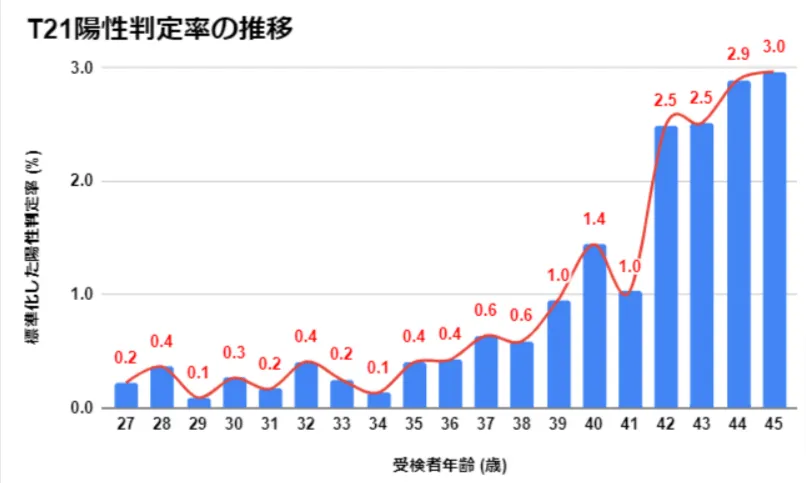
[Survey Overview]
Survey institution: Tokyo Health Inspection Center
Survey subjects: Patients aged 19–51 who underwent NIPT (Non-Invasive Prenatal Testing) at our clinic
Among patients aged 19 to 51 who underwent NIPT at our clinic, the proportion of trisomy 21-positive results among women 35 and older was more than four times that of women under 35 — a pattern explored further in Advanced Maternal Age and Trisomy 21: What the Data Shows (Japanese).
If you would like a more detailed, age-by-age breakdown, or an explanation of testing timing in light of egg aging — including how a partner’s age factors in — see Down Syndrome Risk After 35: Understanding NIPT Through the Mechanism (Japanese) and Advanced Maternal Age Pregnancy and NIPT.
Why Lifestyle Habits Are Not the Cause
The cause of trisomy 21 is chromosomal nondisjunction — there is no medical evidence that diet, lifestyle habits, or stress during pregnancy trigger it. In consultations, I have met many patients who blamed themselves, wondering “did I do something to cause this?” That worry can be set aside.
Nondisjunction is a chance chromosomal event that occurs during the formation of the egg or sperm. It can happen to anyone — that is the reality of nondisjunction. Research attention is focused on the chromosome itself, not on behavioral factors. On X, @sa6na7 shared news of a Mie University research group that succeeded in removing the extra chromosome 21 at the cellular level. It remains an early, cell-level proof of concept — not a treatment for humans or fetuses — but it illustrates clearly where research on the cause is actually focused: the chromosome itself.
Understanding the true cause is a foundation for not blaming yourself. Next, let’s look at exactly what NIPT can and cannot tell you about the cause.
What NIPT Can and Cannot Tell You About the Cause
NIPT is a non-diagnostic screening test that estimates the likelihood of trisomy 21. It does not identify which type of nondisjunction occurred. Distinguishing between the standard, translocation, and mosaic types requires a diagnostic test such as amniocentesis, together with karyotype analysis of the chromosomes themselves.
Patients sometimes ask me, “If I have NIPT, will it tell me the cause too?” NIPT’s role stops at estimating likelihood. On X, @miooo0103 pointed out that the conditions NIPT can screen for are limited — trisomy 21, 18, and 13, among others — and noted that chromosomal causes account for less than 15% of all congenital conditions affecting child development. Keeping NIPT’s actual scope in mind is essential when thinking about the full picture of what causes these conditions.
- What NIPT can tell you: whether the likelihood of trisomy 21 and other target conditions is high or low
- What NIPT cannot tell you: which type — standard, translocation, or mosaic — is responsible
- What’s needed to identify the type: a diagnostic test such as amniocentesis, plus karyotype analysis
For more on the detection range and positive predictive value for trisomy 21 itself, see Trisomy 21, the Cause of Down Syndrome, and What NIPT Covers. For the full picture of prenatal testing, see Down Syndrome, Pregnancy Risk, and Prenatal Testing (Japanese).
Will It Happen Again in a Future Pregnancy? Understanding Recurrence Risk
For standard trisomy 21 caused by nondisjunction, the probability of trisomy 21 in a future pregnancy is reported to be somewhat higher than the baseline risk expected from maternal age alone. As a general guide, the relative risk increases by about 3.5-fold for mothers under 35, and about 1.7-fold for mothers 35 and older.
For the translocation type, however, the picture changes considerably when one parent carries the translocation. The risk range differs depending on whether the mother or the father is the carrier, and on the specific type of translocation involved, which is why confirmation through genetic counseling is essential.
When considering a future pregnancy, confirming the specific type through diagnostic testing and working through the risk together with a specialist tends to bring the most peace of mind. The Department of Genetic Medicine at the National Center for Child Health and Development (Japanese) also provides genetic counseling on recurrence risk for future pregnancies. For an overview of Down syndrome symptoms, characteristics, and testing options, see Down Syndrome (Trisomy 21): Causes, Characteristics, and Testing.
Frequently Asked Questions (FAQ)
Here are answers to questions we often hear in consultations about the cause of trisomy 21.
Is there just one cause of trisomy 21?
No. There are three: the standard type (nondisjunction during meiosis, about 95%), the translocation type (about 4%), and the mosaic type (nondisjunction after fertilization). Each has a different mechanism and a different implication for future pregnancies.
Is maternal age the only cause?
Maternal age strongly influences the probability of nondisjunction, but it is not the only cause. The translocation and mosaic types are only weakly linked to age and can occur even in younger mothers.
Can lifestyle habits or diet cause it?
No. The cause of trisomy 21 is chromosomal nondisjunction, and there is no medical evidence that diet or lifestyle habits during pregnancy trigger it.
Does paternal age play a role?
No link as strong as the one seen with maternal-origin nondisjunction has been confirmed. The relationship between paternal age and chromosomal abnormalities overall is discussed in detail in Down Syndrome Risk After 35: Understanding NIPT Through the Mechanism (Japanese).
Can NIPT tell me which type caused it?
No. NIPT is a non-diagnostic test that estimates the likelihood of trisomy 21. Distinguishing the standard, translocation, and mosaic types requires a diagnostic test such as amniocentesis, together with karyotype analysis.
If we’ve had a child with trisomy 21 before, is the probability the same next time?
For the standard type caused by nondisjunction, the probability is somewhat higher than the baseline risk from maternal age alone (roughly 3.5-fold under 35, roughly 1.7-fold at 35 or older, as a general guide). For the translocation type, the risk varies considerably depending on whether a parent is a carrier — please confirm through genetic counseling.
Is the translocation type always inherited from a parent?
No. In about half of translocation cases, both parents have normal chromosomes and the translocation arose spontaneously. In the other half, one parent may carry the translocation. For details, see Translocation Down Syndrome and NIPT Testing (Japanese).
Summary
The cause of trisomy 21 is, at its core, chromosomal nondisjunction during meiosis. It occurs through three distinct mechanisms — the standard, translocation, and mosaic types. Nondisjunction does become more common as maternal age rises, but lifestyle habits are not the cause: it is a chromosomal event that can happen to anyone.
Because the implications for a future pregnancy depend on which type is involved, confirming the type through diagnostic testing and genetic counseling can bring real peace of mind if you’re concerned. For related reading, see Down Syndrome: Associated Health Conditions and Care (Japanese) and Down Syndrome, Pregnancy Risk, and Prenatal Testing (Japanese).
Medically reviewed by: Hiroshi Oka, MD, PhD — Director, Hiro Clinic (Medical Corporation Fukubikai); Laboratory Director. Graduate of Keio University School of Medicine. Licensed physician in both Japan and the United States; holds a Ph.D. in Medicine and one of the few Laboratory Director qualifications held in Japan. Author of “The Book to Read First When You Learn You’re Pregnant” (Japanese). Our NIPT is a non-diagnostic screening test with high detection accuracy for specific chromosomal changes, including trisomy 21; a diagnostic test such as amniocentesis is required for confirmation. Over 75,000 tests have been performed to date. Testing is conducted in partnership with a domestic testing institution (Tokyo Health Inspection Center), with results delivered on average in about 5 days (as fast as 2). This article was prepared with reference to public institutions and academic literature, in line with medical advertising guidelines. Published figures vary by source; please consult your physician for diagnostic and treatment decisions.
日本皮膚科学会 皮膚科専門医/日本医師会 産業医/東京衛生検査所 指導監督医
この記事は、 ヒロクリニックNIPTの編集・監修体制 にもとづき、資格を持つ医師が内容を確認しています。