What Are Microdeletion and Microduplication Syndromes (Designated Intractable Diseases)?
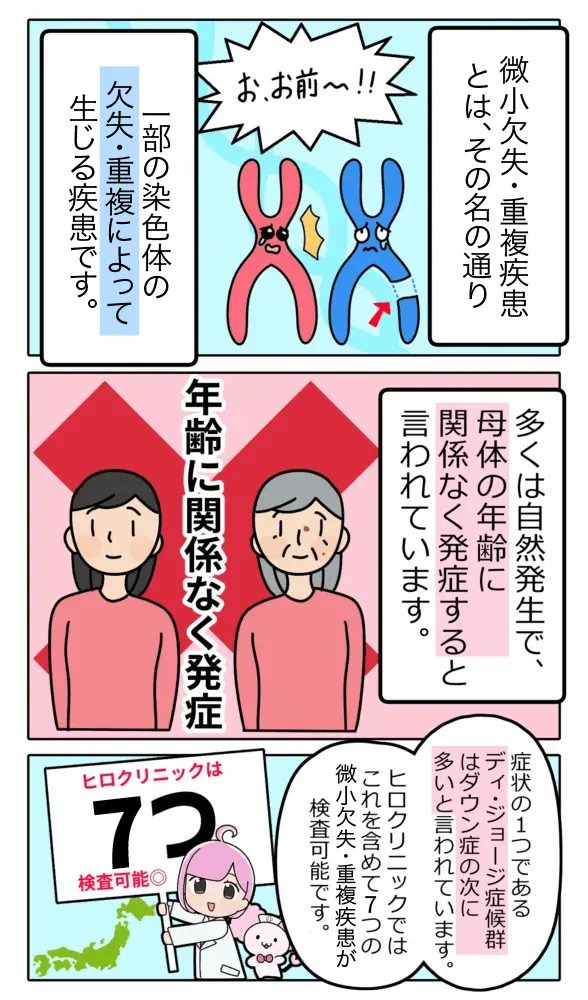
Microdeletion and microduplication syndromes are genetic conditions caused by the deletion or duplication of genes at specific locations on a chromosome.
As the term “micro” suggests, these alterations are small in size, with some spanning as few as 500,000 base pairs. Typically, they are said to result from the loss or gain of sequences ranging from 500,000 to 3,000,000 base pairs. Depending on the size and precise location of the variant, it can lead to a diverse spectrum of clinical symptoms and varying levels of severity, often accompanied by developmental delays such as intellectual disabilities. Furthermore, the vast majority of microdeletion and microduplication syndromes occur sporadically (de novo) and are widely recognized to arise independently of maternal age.
Consequently, it cannot be definitively claimed that screening for these conditions is without clinical value, regardless of whether the pregnant individual is young or of advanced maternal age.
What is the Highly Frequent DiGeorge Syndrome (Designated Intractable Disease 203)?
DiGeorge Syndrome (Designated Intractable Disease 203) is a genetic condition caused by a deletion in a specific region of chromosome 22. This syndrome is known to cause a wide range of manifestations, including immune system problems, heart defects, and characteristic facial differences. Although it is a relatively rare condition, it can have serious implications for affected individuals and their families.
Detection Track Record via Hiro Clinic’s NIPT Screenings
From 3,322 screenings conducted at Hiro Clinic, 5 cases of genetic abnormalities associated with DiGeorge Syndrome were identified. This frequency—approximately 1 in 600 cases—is significantly higher than the general epidemiological data of 1 in 4,000 to 6,000 individuals, demonstrating the high detection capability of DiGeorge Syndrome (Designated Intractable Disease No. 203). This outcome strongly supports Hiro Clinic’s advocacy for the clinical importance of microdeletion and microduplication screening. Particularly for pregnant individuals and families considered to be at a higher genetic risk, this screening provides vital information that enables early intervention and preparation.
Microdeletion and Microduplication Syndromes Screenable via Hiro Clinic NIPT
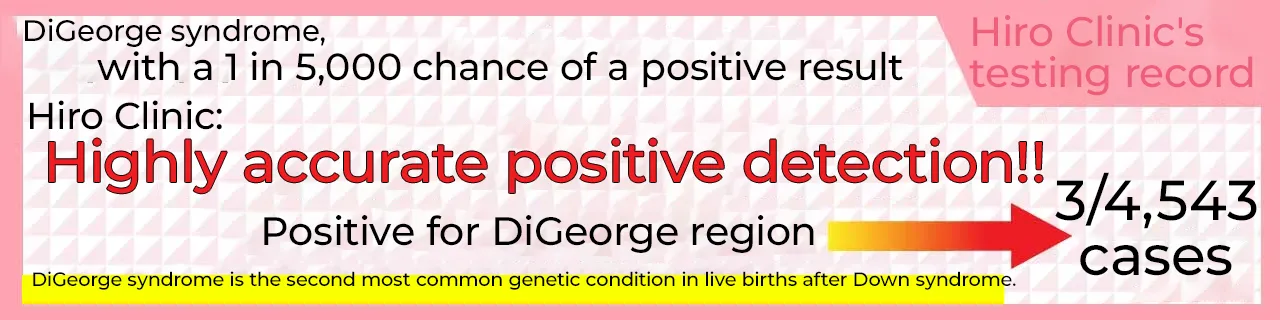
In terms of the population currently living with the condition, DiGeorge Syndrome (Designated Intractable Disease 203) is said to be the second most common after Down syndrome. This is thought to be correlated with its relatively favorable life prognosis. Including DiGeorge syndrome, Hiro Clinic NIPT can screen for a total of 143 types of microdeletion and microduplication syndromes. All testing procedures are conducted domestically within Japan.
| Condition Name | DiGeorge Syndrome | 1p36 Deletion Syndrome | Smith-Magenis Syndrome | Wolf-Hirschhorn Syndrome | Cri-du-Chat Syndrome (Cat Cry Syndrome) | Prader-Willi Syndrome | Angelman Syndrome |
|---|---|---|---|---|---|---|---|
| Affected Region | 22q11.2 | 1p36 | 17p11.2 | 4p16.3 | 5p- | 15q11.2 | 15q11.2 |
| Maximum Frequency | 1/2000 | 1/5000 | 1/15000 | 1/50000 | 1/15000 | 1/10000 | 1/12000 |
| Minimum Frequency | 1/6000 | 1/10000 | 1/25000 | 1/96000 | 1/50000 | 1/15000 | 1/20000 |
Screening Track Record at Hiro Clinic
Hiro Clinic, which has performed over 75,000 NIPT (Non-Invasive Prenatal Testing) procedures (*1) to date, has conducted microdeletion and microduplication syndrome screening for 4,543 individuals (*2).
Out of these 4,543 individuals, 1 person received a definitive positive screening result for DiGeorge syndrome, which was subsequently confirmed as a true positive via invasive diagnostic testing. Additionally, among 5 individuals whose results were initially classified as uninformative (inconclusive), 2 underwent amniocentesis; consequently, 1 case of 22q11.2 duplication and 1 case of Emanuel syndrome were detected. The case diagnosed as Emanuel syndrome returned an amniocentesis karyotype of 47,XY,+der(22)t(11;22)(q23.3;q11.2), an abnormality involving a reciprocal translocation between position q23.3 on chromosome 11 and position q11.2 on chromosome 22. Although the targeted DiGeorge screening is designed to detect microdeletions at the 22q11.2 locus, the chromosomal displacement at this exact site triggered an abnormal flag. This demonstrates that Hiro Clinic’s NIPT screening can detect structural variations related to duplications and translocations, not just microdeletions. No follow-up reports were received for the remaining 3 uninformative cases. Furthermore, out of 5 cases classified as highly likely to be positive (borderline results), 2 were subsequently confirmed negative via amniocentesis, while the remaining 3 did not undergo amniocentesis.
DiGeorge syndrome is a condition caused by a microdeletion on chromosome 22, with an estimated prevalence of approximately 1 in 4,000 to 6,000 individuals in the general population. Through microdeletion and microduplication screening, aberrations localized within the same targeted chromosomal regions may also be discovered. Thus far, at least 3 out of 4,543 individuals have had deletions or duplications in the 22q11.2 region confirmed via invasive diagnostic testing. The following table will be updated as soon as follow-up data from individuals who have not yet undergone invasive testing becomes available.
| NIPT Result | Amniocentesis Positive | Amniocentesis Negative | Not Performed / Unreported | |
|---|---|---|---|---|
| Positive | 1 | 1 | 0 | 0 |
| Highly Likely Positive | 6 | 0 | 2 | 4 |
| Uninformative | 5 | 2 | 0 | 3 |
All of these 1,391 cases include screening for microdeletion and microduplication syndromes.
| DiGeorge Syndrome | 1p36 Deletion Syndrome | Cri-du-Chat Syndrome | Wolf-Hirschhorn Syndrome | Angelman Syndrome | |
|---|---|---|---|---|---|
| Number of Positives | 0 cases | 0 cases | 0 cases | 0 cases | 0 cases |
| DiGeorge Syndrome |
1p36 Deletion Syndrome |
Cri du Chat Syndrome |
Wolf-Hirschhorn Syndrome |
Angelman Syndrome |
|
|---|---|---|---|---|---|
| Number of Positive Cases | 0 cases | 0 cases | 0 cases | 0 cases | 0 cases |
Since approximately 43% of pregnant women have a fetal fraction (FF) of 10% or lower, performing microdeletion screening for DiGeorge syndrome carries a high risk of false negatives.
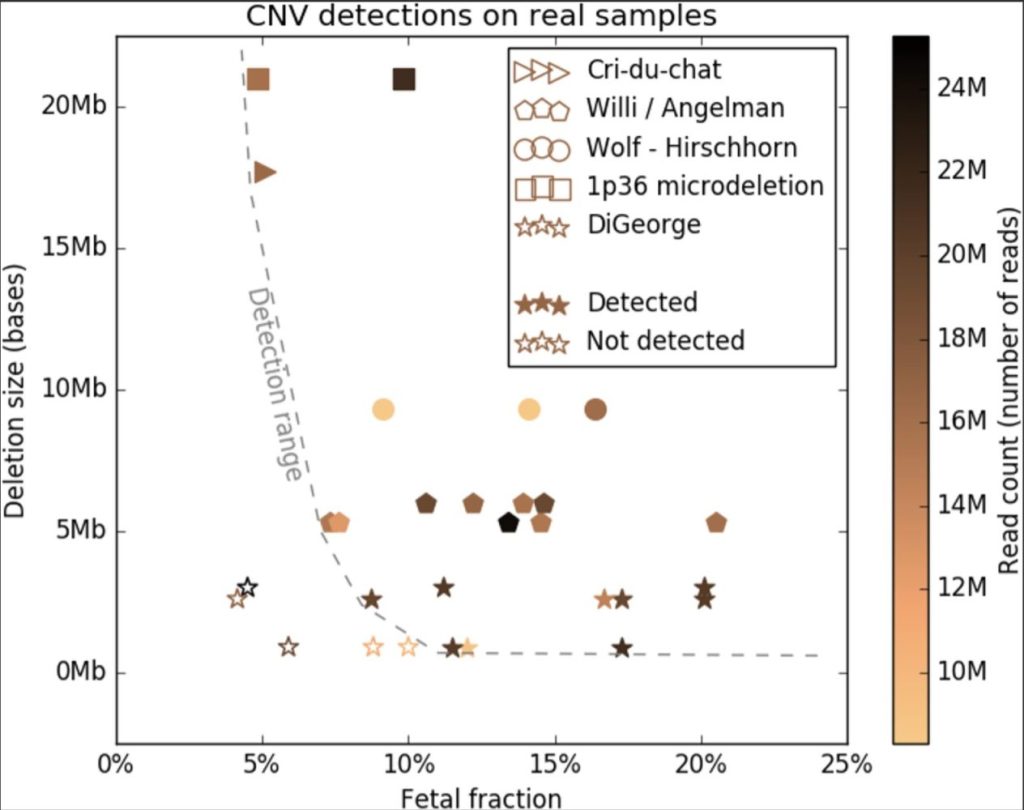
For DiGeorge syndrome, they are represented by ☆ and ★. ☆ represents cases that were actually positive but diagnosed as negative. ★ represents cases correctly diagnosed with DiGeorge syndrome. The vertical axis represents the deletion size. Most stars are located below 3 Mb. This is because about 90% of DiGeorge syndrome cases occur at 3 Mb or less. The dotted curve line is the detection limit threshold. Cases located below this line will be false negatives. In other words, cases that should come out positive end up negative. The five ☆ in the lower left are those cases. 5 out of 14 cases are false negatives. This means the sensitivity is 71.4%.

At Hiro Clinic, the distribution of fetal fraction (FF) is shown above. As of June 2024 data, the proportion of patients with an FF of 10% or less is 43.7%. This means that nearly half of the patients have an FF of 10% or less, which may result in a false negative for DiGeorge syndrome.
DiGeorge Syndrome Overview and Symptoms
DiGeorge syndrome is a genetic disorder caused by the deletion of specific genes. This syndrome can lead to a variety of symptoms, including hypoplasia of the thymus and parathyroid glands, congenital cardiovascular anomalies, and distinctive facial features. Additionally, it is characterized by immune system problems, recurrent infections, and speech difficulties due to a submucous cleft palate.
Emanuel Syndrome Overview and Symptoms
A phenomenon where parts of chromosomes swap places is called a chromosomal translocation. Due to this, translocation carriers face risks of miscarriage and infertility when trying to have children. In particular, translocation between chromosomes 11 and 22 can lead to Emanuel Syndrome. Diagnosed through specific genetic testing, this syndrome causes severe chromosomal abnormalities, including congenital heart disease, cleft palate, imperforate anus, and kidney malformations.
22q11.2 Microduplication Syndrome Overview and Symptoms
Caused by a duplication of a portion of chromosome 22, congenital heart disease is observed in 80% of patients. Tetralogy of Fallot is particularly representative, involving ventricular septal defect, overriding aorta, and other anomalies. Cardiovascular diseases significantly impact prognosis, alongside a wide variety of other clinical symptoms.
| Survey Period | June 2020 – November 2023 | April 2023 – March 2024 |
|---|---|---|
| Survey Institution (Survey Conducted By) |
Tokyo Medical Laboratory | |
| Target Population | Patients aged 19 to 51 who underwent NIPT (Non-Invasive Prenatal Testing) at our clinic | |
| Valid Responses (Sample Size) |
Approx. 75,000 cases | 4,543 cases |
Deletion Sites of the 7 Microdeletion and Duplication Syndromes
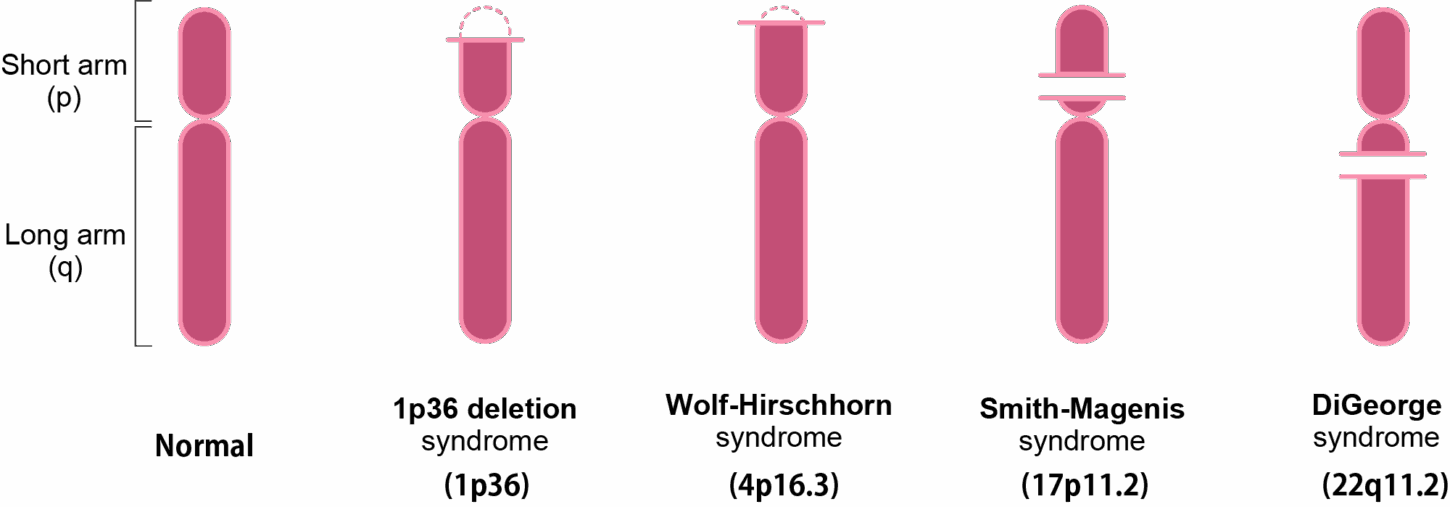
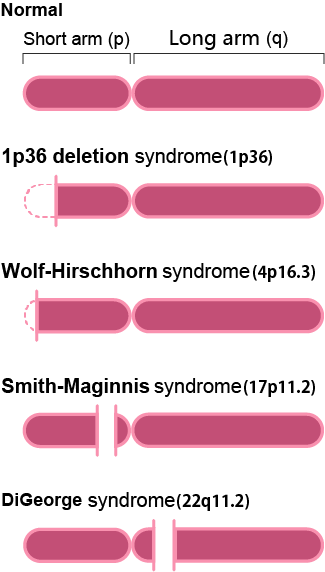
The 7 microdeletion and duplication syndromes are conditions caused by minute deletions in specific regions: the “long arm of chromosome 22,” “short arm of chromosome 1,” “short arm of chromosome 17,” “short arm of chromosome 4,” “short arm of chromosome 5,” and “long arm of chromosome 15.”
In the affected sites listed below, the very first number indicates the chromosome number, followed by “p” for the short arm and “q” for the long arm. The short arm refers to the upper section of the chromosome, and the long arm refers to the lower section. The next number indicates the specific region counted from the central centromere, and the “-” (minus sign) signifies that this region is deleted.
If the Result is Positive, Amniocentesis is Recommended
If your test result is positive, our clinic strongly recommends undergoing amniocentesis. Following amniocentesis, the amniotic fluid must be analyzed using microarray analysis or exome sequencing.
The reality is that very few testing facilities in Japan perform these specific analyses. If you wish to proceed with analysis and confirm your condition, please consult with our clinic. We will introduce you to a suitable testing facility.
日本皮膚科学会 皮膚科専門医/日本医師会 産業医/東京衛生検査所 指導監督医
この記事は、 ヒロクリニックNIPTの編集・監修体制 にもとづき、資格を持つ医師が内容を確認しています。