

Article Summary
Whole Exome Sequencing (WES) is a genetic test that selectively analyzes the “exon regions”—the protein-coding sequences that make up approximately 1% to 2% of the human genome. Because roughly 85% of known disease-causing variants associated with genetic disorders are concentrated within these specific regions, WES allows for comprehensive screening of single-gene disorder risks in a cost- and time-efficient manner. While standard Non-Invasive Prenatal Testing (NIPT) is a non-definitive screening test performed via a maternal blood draw to detect “chromosomal numerical abnormalities” (such as trisomies 13, 18, and 21), exome sequencing serves a distinct clinical purpose by analyzing “individual gene variants” at a far more detailed molecular level. At Hiro Clinic, for patients undergoing amniocentesis as a confirmatory test following a positive NIPT result, we offer complimentary insights and guidance on exome sequencing in collaboration with domestic laboratory partners. However, even the most advanced genetic testing has its limitations. Key considerations—such as the potential detection of Variants of Uncertain Significance (VUS) and the fact that no test can detect all possible medical conditions—are essential to understand before deciding to move forward with testing.
Key Takeaways in This Article
- What Whole Exome Sequencing (WES) is, its clinical role, and how it differs from standard NIPT
- What WES can detect (single-gene disorders, de novo variants, and submicroscopic structural variations)
- Eligible clinical scenarios, testing procedures, required samples, and turnaround times
- Limitations and important considerations (non-definitive aspects, variants of uncertain significance, and the necessity of genetic counseling)
- Cost breakdowns, plan positioning, and frequently asked questions
In recent years, rapid advancements in medical technology have made genetic testing increasingly accessible for parents seeking deeper insights into their baby’s health as well as their own genetic traits. Among these technologies, the term Whole Exome Sequencing (WES)—often referred to simply as exome sequencing—is gaining widespread attention.
Hiro Clinic has conducted over 75,000 NIPT procedures to date, earning a 98.8% patient satisfaction rate (as surveyed by EasyCloud Co., Ltd. in December 2023). Moving beyond standard NIPT offerings, we have built a comprehensive testing framework that integrates advanced exome sequencing expertise, delivering rigorous post-test care and support tailored to each patient’s needs. Under medical supervision, this article breaks down complex terminology to explain how exome sequencing works, how it differs from standard NIPT and Whole Genome Sequencing (WGS), who is eligible, and the clinical limitations to consider.
What is Whole Exome Sequencing (WES)? Differences from Standard NIPT
A Technology That Targets Only the “Meaningful Parts” of Genes
The human genome, which serves as the blueprint for our bodies, consists of roughly 3 billion base pairs (the letters of DNA). However, not all of these base pairs contain the instructions for producing the proteins that build our bodies.
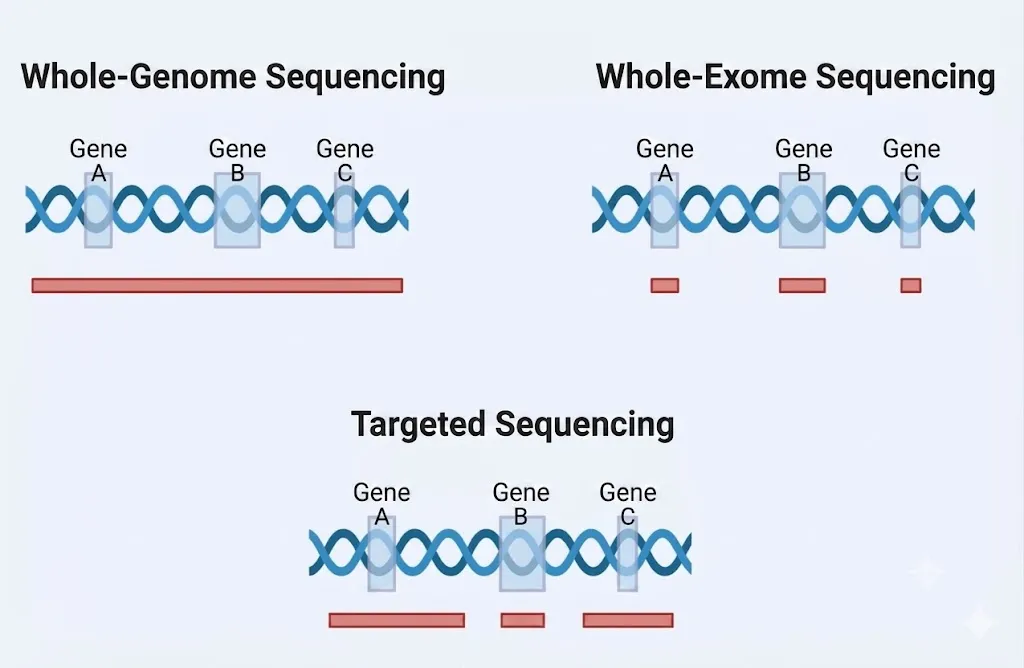
The regions containing the blueprints for proteins are called “exons,” while the remaining regions, whose functions are not yet fully understood, are known as “introns.” Exons account for a mere 1% to 2% of the entire human genome. Remarkably, despite making up such a small fraction, approximately 85% of known disease-causing variants associated with genetic disorders are concentrated within these exon regions.
Whole Exome Sequencing (WES) is a technique that selectively extracts and intensively analyzes this 1% to 2% “exon region” (the exome) using specialized technology. To visualize this, imagine that instead of reading every single page of a massive dictionary from cover to cover, you efficiently focus only on the index where the most critical entries are compiled. When explaining this test in my outpatient clinic, I always begin by discussing this difference in scope. I find that helping patients picture what the test actually examines is the quickest way to build a clear understanding before introducing technical terminology.
Examining Different Targets with Distinct Analytical Precision
It is understandable why some might think, “Since I have already taken an NIPT, I do not need exome sequencing.” However, these two tests evaluate entirely different targets. Standard NIPT is a non-definitive screening test that uses fetal DNA fragments found in maternal blood to detect “chromosomal numerical abnormalities,” such as trisomies 13, 18, and 21. Whole exome sequencing, on the other hand, evaluates the precise “sequence (spelling)” of individual genes rather than the number of chromosomes, delving into the evaluation of single-gene disorders that fall outside the scope of standard NIPT. The Japan Society of Obstetrics and Gynecology also provides public information regarding the clinical role of NIPT.
| Comparison Item | Standard NIPT | Whole Exome Sequencing (WES) |
|---|---|---|
| Target Analyzed | Changes in chromosome numbers (Trisomies 13, 18, 21, etc.) | Gene sequence variations (Single-gene disorders) |
| Sample Type | Maternal blood (cfDNA) | Primarily amniotic fluid (chorionic villi or blood may also be used) |
| Nature of the Test | Non-definitive test (Screening) | Close to direct mutation detection, though limitations exist in determining clinical significance |
| Testing Period | Available from early pregnancy | Primarily available from the period when amniocentesis can be performed |
| Clinical Role | Initial screening test | In-depth diagnostic testing to investigate detailed underlying causes |
In short, standard NIPT and Whole Exome Sequencing (WES) should not be viewed in terms of “which one is superior.” Rather, it is most accurate to understand them as complementary tests that evaluate different levels of biological structure. They serve distinct roles: NIPT assesses the number of chromosomes, while exome sequencing evaluates changes in gene sequences. Combining the results of both tests provides a more comprehensive, multi-angle view of the baby’s health.
Next-Generation Sequencing (NGS) and the Science of Analytical Precision
What enabled exome sequencing to be applied in clinical practice is the technology known as Next-Generation Sequencing (NGS). NGS can read tens to hundreds of millions of short DNA fragments simultaneously and at high speeds.
Understanding “Coverage (Depth)” as the Basis of Reliability
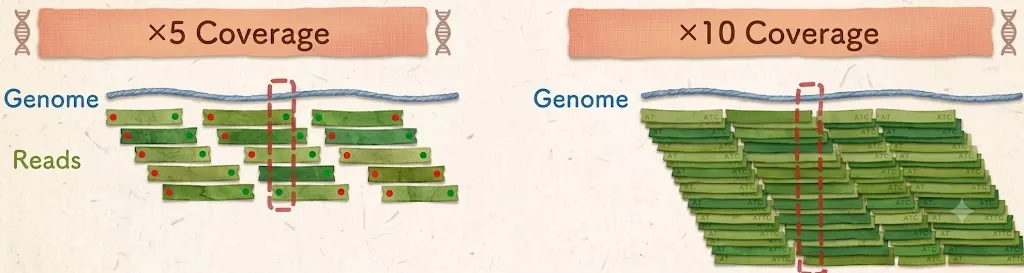
In genetic testing, it is crucial not only to ask whether a sequence was read, but also how accurately and reliably it was read without error. The benchmark used to measure the reliability of this analytical data is “coverage” (an indicator showing the depth of sequencing).
Coverage (C) represents the average number of times a specific target DNA region has been repeatedly read by the sequencer. Letting L be the read length per sequence, N be the total number of reads, and G be the total number of base pairs in the target region, coverage is defined by the following equation:
C=L×N/G
For example, even in subtle cases where a specific genetic variant is present in only trace amounts within a sample, setting a higher (deeper) coverage C to read the region repeatedly makes it easier to detect the variant without it being obscured by machine noise. The domestic laboratory affiliated with Hiro Clinic (Tokyo Health Laboratory) aims for a “100x depth” standard to ensure data acquisition that minimizes the risk of missing variants.
What Whole Exome Sequencing Can Reveal
Whole Exome Sequencing mainly evaluates single-gene disorders, de novo mutations, and certain microscopic structural variants. Let’s look at each of these in turn.
Single-Gene Disorders
Conditions caused by a variant in a single gene are known as “single-gene disorders.” There are over 200 such conditions, including those affecting bone and cartilage development, cardiac structure, and neurodevelopment. Whole Exome Sequencing is a test capable of broadly searching the exon regions for variants that could cause these single-gene disorders. For further details on single-gene disorders themselves, please refer to our dedicated explanatory article on single-gene disorders.
De Novo Mutations
When people hear “single-gene disorders,” they often assume, “I only need to worry if someone in my family has the condition.” In reality, however, that is not always the case. Many of the variants identified through exome sequencing are “de novo mutations”—new variants that arose in the baby’s generation and were not inherited from either parent. It is an important fact to keep in mind that the absence of a family history does not mean the risk of a single-gene disorder is zero.
Microscopic Structural Abnormalities
In addition to single-base changes, exome sequencing can also detect relatively small deletions and duplications (copy number variations) restricted within exon regions. However, as discussed below, detecting large structural abnormalities that span across entire chromosomes is not a primary strength of exome sequencing. Because the most appropriate testing method depends on what you wish to evaluate, it is essential to consult with your physician to determine how far your investigation should extend.
Differences from Whole Genome Sequencing (WGS) and Microarray Testing
There are several methods for examining genes and chromosomes. Let’s compare their respective features.
| Comparison Item | Whole Exome Sequencing (WES) | Whole Genome Sequencing (WGS) | Microarray Testing |
|---|---|---|---|
| Target Analyzed | Exon regions (Approx. 1–2%) | Entire genome (100%) | Microscopic deletions and duplications in specific chromosomes |
| Primary Strengths | Identifying known disease-causing genes; efficient analysis | Exploring unknown regions; detecting complex structural abnormalities | Detecting numerical abnormalities and structural variants at the chromosome level |
| Data Volume & Turnaround Time | Relatively small; analysis and reporting tend to be faster | Extremely vast; requires time for analysis and data storage | Relatively fast |
| Cost Range | More manageable compared to WGS | Tends to be expensive | Moderate |
Whole Exome Sequencing (WES) focuses its analytical resources on the “meaningful regions” that are directly linked to clinical conditions, making it a test with an excellent balance of cost and comprehensiveness. On the other hand, if you wish to conduct a broader investigation that includes non-coding regions as well, Whole Genome Sequencing (WGS) serves as an alternative option. For a more detailed explanation of WGS, please refer to our dedicated article on Whole Genome Sequencing (WGS).
Eligible Cases
At Hiro Clinic, we offer free access to testing frameworks incorporating insights from Whole Exome Sequencing for patients who test positive on an NIPT and proceed with amniocentesis as a confirmatory test. In addition, Whole Exome Sequencing may also be considered in consultation with a physician in the following scenarios:
- When ultrasound examination reveals findings of concern (such as structural abnormalities) and you wish to investigate the underlying cause in greater detail.
- When there is a family history of a hereditary condition and you wish to understand the associated risks more thoroughly.
- When you wish to evaluate risks for single-gene disorders that fall outside the scope of standard NIPT.
If you are unsure whether these scenarios apply to your situation, we strongly encourage you to consult with a physician during your counseling session rather than making a decision on your own. If you are uncertain about which testing plan to choose, you are also welcome to use our Plan Diagnostic Tool.
Many patients come to their consultations feeling hesitant, asking themselves, “Is this a test I really ought to take, or can I skip it?” Whenever I address these concerns, the first point I emphasize is that “taking the test itself is not the ultimate goal.” The essential first step is to sit down together and carefully weigh the volume of information the test yields against the specific answers your family actually seeks. There is no need to rush into a decision.
Testing Process, Required Samples, and Turnaround Time
At Hiro Clinic, our genetic testing (including NIPT and amniocentesis-based analysis) proceeds through the following steps:
- Booking & Counseling: Please schedule your appointment through our 24-hour web reservation system. During an online counseling session, a physician will listen to your concerns and discuss your testing preferences.
- Sample Collection: For NIPT, a maternal blood sample (approx. 10 mL) is collected at our clinic. For Whole Exome Sequencing, the analysis primarily utilizes amniotic fluid collected during an amniocentesis procedure.
- Analysis at a Domestic Laboratory: At our partner facility, the Tokyo Health Laboratory, dedicated equipment enriches the exon regions, which are then sequenced using Next-Generation Sequencing (NGS) technology.
- Bioinformatics Analysis: From the massive volume of sequencing data generated, clinically meaningful variants are extracted and cross-referenced against established disease databases.
- Results & Consultation: As soon as your results are available, they will be reported via your MyPage patient portal and explained directly by a physician. Follow-up guidance and advice regarding next steps will be provided as needed.
Because standard NIPT samples are analyzed domestically in Japan, results can typically be reported in as little as a few days. In contrast, Whole Exome Sequencing processes a vastly larger volume of data than standalone NIPT, requiring a longer timeframe for detailed analysis. Because exact turnaround times vary depending on the condition of the sample, your physician will provide a personalized estimate during your counseling session.
For phone inquiries: 0120-169-629
Limitations and Considerations of Testing
While Whole Exome Sequencing is an exceptionally useful tool, it is not an all-powerful test. At Hiro Clinic, our commitment is to clearly communicate these inherent limitations so you are fully informed before undergoing testing.
- Non-Exonic Regions Are Not Evaluated: Abnormalities located in the remaining 98% of the genome that does not directly code for proteins (such as regions regulating gene function) cannot be detected by this test.
- Unsuited for Large Structural Variants: For large chromosomal structural changes—such as significant deletions, duplications, or translocations—other diagnostic methods, such as microarray testing, may be more appropriate.
- Possibility of Identifying “Variants of Uncertain Significance” (VUS): In some cases, a variant is detected, but current medical knowledge cannot determine whether it causes disease or is simply a benign individual variation. These are classified as “Variants of Uncertain Significance” (VUS).
- Potential for Incidental Findings: Occasionally, variants associated with a different health risk unrelated to the primary condition being evaluated may be discovered by chance.
- Does Not Detect All Conditions: Conditions that are not genetic in origin, or those caused by mechanisms not yet fully understood by medical science, cannot be identified through this test alone.
Because these limitations exist, genetic counseling is an essential component of interpreting your results. Rather than attempting to digest numerical data or test classifications on your own, it is crucial to take the time to review what these findings mean and explore your family’s options together with a qualified physician. At Hiro Clinic, our specialized physicians explain these limitations thoroughly and recommend testing plans tailored to each patient’s individual circumstances. For further information on instances where testing yields an inconclusive result, please refer to our article on the reasons why an inconclusive result may occur.
The Significance of Genetic Counseling
The results of Whole Exome Sequencing cannot be fully understood simply by looking at the numerical data or diagnostic terms on a test report. The true essence of genetic counseling lies in the collaborative process of sitting down with a specialized physician or counselor to decipher what these results genuinely mean for your family.
Preventing You from Carrying the Burden Alone
In my clinical practice, I frequently meet patients who receive their test results and immediately attempt to draw conclusions based solely on fragmented information found on the internet. However, when results contain Variants of Uncertain Significance (VUS) or incidental findings, interpreting them without specialized medical knowledge can lead to unnecessary anxiety. In genetic counseling, we set aside dedicated time not only to clarify the medical implications of your results, but also to explore how to process and navigate this information together.
Neutral Information Delivery Without Influencing Your Choices
Genetic counseling never seeks to steer you toward a specific course of action. Our core principle is to present medical facts neutrally so that your family can make informed, confident decisions based on the information obtained. Supported by an integrated care framework uniting specialists in obstetrics and gynecology, pediatrics, and clinical genetics, we foster an approachable environment where you can freely voice your questions and concerns at any step.
Counseling is not a one-time conversation. Questions often arise long after the initial discussion, not just in the moments immediately following the receipt of your results. At Hiro Clinic, we maintain a supportive framework that allows you to return for consultations whenever new questions surface. Given the complex nature of genomic medicine, please never hesitate to ask about anything you find unclear. For those interested in learning more about national research and support systems in genomic medicine, resources provided by the Japan Agency for Medical Research and Development (AMED) offer helpful references.
Costs and Plan Structure
At Hiro Clinic, we offer free access to testing frameworks incorporating insights from Whole Exome Sequencing for patients who test positive on an NIPT and proceed with amniocentesis. Because available testing plans vary depending on your gestational age and individual preferences, we recommend starting with our Plan Diagnostic Tool to review an overview of your options. Detailed information regarding specific costs and plan structures can be found on the Plan Diagnostic page linked below, or discussed in depth during an online counseling session.
When evaluating costs, it is important to consider not just the standalone price of the test, but the complete journey—including how you will receive the results and how you will navigate the steps that follow. Please feel free to ask about our overall support framework, which encompasses dedicated counseling time and financial assistance programs for amniocentesis. For those considering Whole Genome Sequencing (WGS) as well, we provide a side-by-side comparison that includes the cost differences between options.
Quick Reference Guide by Patient Category
| Patients proceeding with amniocentesis as a confirmatory test following a positive NIPT result | Provided free of charge |
| Cases other than the above (ultrasound findings, family history, etc.) | Guided via Plan Diagnostic Tool or counseling |
You can confirm which category applies to you using the Plan Diagnostic Tool below or during an online counseling session.
Frequently Asked Questions (FAQ)
Q. Will Whole Exome Sequencing detect all diseases or health conditions in my baby?
A. No, it does not detect all conditions. While Whole Exome Sequencing is highly effective for identifying known inherited genetic disorders, it cannot detect conditions that are not genetic in origin or those caused by variations in regions outside the exome (non-coding regions).
Q. Is the complimentary Whole Exome Sequencing during amniocentesis available to everyone?
A. This offer is available to patients who received a positive NIPT result at Hiro Clinic and are proceeding with amniocentesis as a confirmatory test. Usage may require a referral or request form from your attending obstetrician, so please discuss the details during your counseling session.
Q. How long does it take to receive the results?
A. Because Hiro Clinic partners with a domestic clinical laboratory (Tokyo Health Inspection Center), there are no delays associated with overseas sample transport. However, because Whole Exome Sequencing processes a significantly larger volume of data than standalone NIPT, receiving reports takes longer than standard NIPT testing. A specific timeframe will be provided by your physician during your counseling session.
Q. What happens if a Variant of Uncertain Significance (VUS) is found?
A. Even if a variant is detected, current medical knowledge may not yet be able to determine whether it directly causes a health condition. In such cases, rather than rushing to conclusions, we use genetic counseling sessions to systematically clarify what is currently known and unknown, allowing you to discuss future steps together with your physician.
Q. Should I choose Whole Exome Sequencing (WES) or Whole Genome Sequencing (WGS)?
A. Most patients begin by considering Whole Exome Sequencing, as it offers an excellent balance between comprehensiveness and cost-efficiency. If you wish to examine a broader range of the genome, or if WES does not identify a cause, Whole Genome Sequencing (WGS) becomes an option. You can decide which test is most appropriate after consulting with your physician.
Q. Is support provided when explaining results and for post-test care?
A. Yes. At Hiro Clinic, our collaborative medical team—comprising specialists in obstetrics and gynecology, pediatrics, and clinical genetics—thoroughly explains the medical significance of your results and your family’s available options through genetic counseling. You do not have to carry the burden of these results alone; please do not hesitate to reach out. Furthermore, support is not limited to the period immediately after receiving your results—you are welcome to return for follow-up consultations whenever new questions arise.
Q. If no variant is found (a negative result), can I assume everything is completely fine?
A. Even if no specific variant is identified through Whole Exome Sequencing, it does not completely rule out all possible health conditions. This is because conditions stemming from non-coding regions or mechanisms not yet fully understood by modern medicine lie outside the scope of this test. It is essential to understand the true nature of this result: rather than meaning “no abnormalities exist anywhere,” it means “no variants were detected within the scope examined by this test.”
Author & Supervisor
Hiroshi Oka, M.D., Ph.D. / Executive Medical Director and Lab Director, Hiro Clinic (Fukubukai Medical Corporation). After graduating from the Keio University School of Medicine, Dr. Oka passed the medical licensing examinations in both Japan and the United States and obtained his Ph.D. in Medicine. He holds the prestigious Lab Director qualification, held by only about 20 individuals in Japan. He also serves as a visiting faculty member at a professional university and shares evidence-based insights on pregnancy and prenatal diagnosis through platforms such as his YouTube channel, “Dr. Hiroshi’s Evidence-Based Pregnancy Channel.” References: Japan Society of Human Genetics, The Japan Medical Association Guidelines for Genetic Testing and Diagnosis in Medical Practice, and our Editorial and Supervision Policy.