What You Will Learn on This Page
- What can be analyzed and how far the 143 Microdeletion and Duplication Syndromes Screening reaches.
- The key differences between the comprehensive 143 conditions test and the 23 major conditions test.
- The difference between “microdeletions/duplications” and “partial deletions/duplications”.
- An easy-to-understand breakdown of Whole Genome Sequencing (WGS) used in the screening.
- The difference between a “positive” result and a “definitive diagnosis”, as well as its relationship to amniocentesis.
Difference Between 143 and 23 Microdeletion/Duplication Condition Screenings
Hiro Clinic offers two main types of microdeletion and duplication tests: the comprehensive 143 conditions screening explained on this page, and the 23 major conditions screening. Please choose the option that best fits your needs.
| Item | 143 Conditions (This Page) | 23 Major Conditions (Separate Page) |
|---|---|---|
| Target Conditions | Up to 143 microdeletion & duplication syndromes | 23 major syndromes, focusing on designated intractable diseases |
| Laboratory Location | Domestic Laboratory in Japan (Tokyo Health & Sanitation Laboratory) | Domestic Laboratory in Japan (Tokyo Health & Sanitation Laboratory) |
| Turnaround Time | Fastest reporting in 2 to 5 days via domestic analysis | Fastest reporting in 2 to 5 days via domestic analysis |
| Features | Comprehensive screening with the largest number of detectable conditions | Includes clinical testing data from our clinic and detailed explanations of deletion sites |
Key Terms to Know
- Microdeletion / Microduplication
- A condition where a tiny segment of a chromosome (approx. 500,000 to 3,000,000 base pairs) is missing or duplicated, potentially leading to developmental delays and other symptoms.
- Whole Genome Sequencing (WGS)
- An analytical method that comprehensively reads the entire genetic sequence, allowing for detailed examination down to minute alterations.
- cfDNA (Cell-Free DNA)
- Fragments of DNA circulating freely in the mother’s bloodstream. Since these fragments include DNA derived from the fetus, testing can be conducted through a simple maternal blood draw.
- Autosomal Dominant / Autosomal Recessive
- Dominant inheritance means symptoms are likely to appear with a change in just one copy of a gene, whereas recessive requires changes in both copies (replacing older terms like “dominant/recessive traits”). Most microdeletions and duplications occur as new variations (*de novo*) in the fetus rather than being inherited from parents, and occur independently of maternal age.
In addition to Down syndrome and DiGeorge syndrome, Hiro Clinic offers screening for 143 microdeletion and duplication syndromes associated with intellectual disabilities. With a simple blood test available starting from the 10th week of pregnancy, we screen for the most common chromosomal abnormalities that could impact your baby’s future.

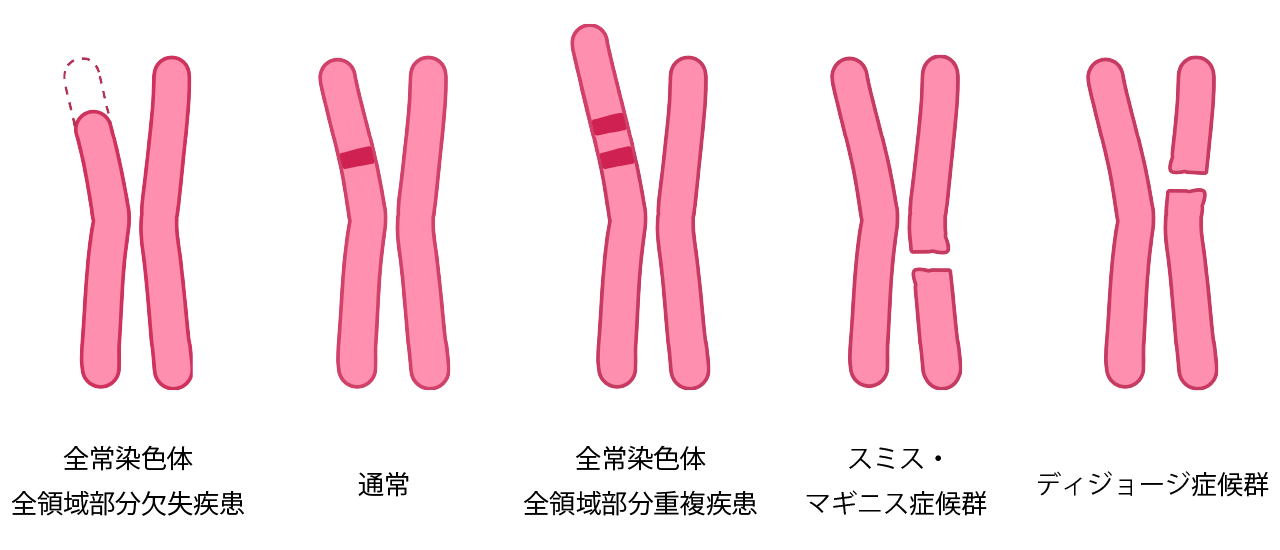
① All Autosomal Regions Partial Deletion Syndromes
② Normal
③ All Autosomal Regions Partial Duplication Syndromes
④ Smith-Magenis Syndrome
⑤ DiGeorge Syndrome
Incidence of Chromosomal Abnormalities and Hereditary Disorders
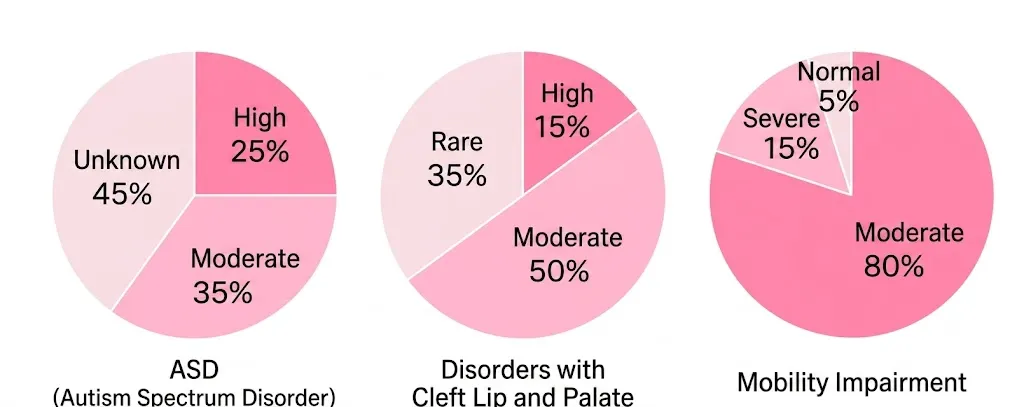
The 143 types of microdeletions are generally estimated to occur in about 1 in 200 to 300 individuals. In other words, they are not particularly uncommon at birth and are by no means rare conditions. Additionally, in approximately 75% of these cases, severe intellectual disability is observed, often requiring significant support in daily life and learning.
Among these, the comorbidity of Autism Spectrum Disorder (ASD) is particularly notable. In about 20% to 25% of cases, a high rate of ASD comorbidity has been confirmed. Additionally, in around 30% to 35% of cases, the risk of ASD is considered slightly elevated, and mild characteristics in behavior or communication may be observed. On the other hand, the remaining 40% to 50% represent cases where an association with ASD is rare or not yet fully understood.
As for cleft lip and palate, high-frequency comorbidity is known to occur in approximately 10% to 15% of cases overall. In around 50% of cases, it is described as “occasionally seen” or “frequently reported,” whereas in the remaining 30% to 40% range, it is rarely seen or reported extremely infrequently.
Congenital heart disease is even more common, confirmed to co-occur in more than two out of three patients—in other words, the majority. Conditions related to heart structure and function make up most of these, and early diagnosis along with appropriate medical intervention are often required.
Regarding walking and motor development, some degree of delay or difficulty is reported in approximately 80% to 90% of all cases. Among these, about 10% to 15% involve cases where walking itself is difficult or long-term support is required. However, there are also a few cases with only mild delays or virtually no impact.
In terms of life expectancy, not all cases result in a shortened lifespan. For more than half of these conditions, there are multiple reports of individuals surviving into adulthood, indicating that with proper medical care and daily support, living a long life is entirely possible.
| Down Syndrome | Patau Syndrome | Edwards Syndrome | Klinefelter Syndrome | Turner Syndrome (45,X) | DiGeorge Syndrome | Charcot-Marie-Tooth Disease Type 1A (CMT1A) | |
|---|---|---|---|---|---|---|---|
| 47,+21 | 47,+13 | 47,+18 | 47,XXY | 45,X | 46,del(22)(q11.2) | 46,dup(17)(p12) | |
| Estimated Incidence | 0.100–0.319% | 0.020–0.029% | 0.02% | 0.200–0.100% | 0.050–0.040% | 0.014–0.026% | 0.008–0.026% |
Akhtar F, Bokhari SRA. Down Syndrome. [Updated 2023 Aug 8]. In: StatPearls [Internet]. Treasure Island (FL): StatPearls Publishing; 2025 Jan-. Available from: https://www.ncbi.nlm.nih.gov/books/NBK526016/ Orphanet. (Last updated September 2023). Trisomy 13 syndrome. Reviewed by Pr Alain VERLOES. Retrieved from https://www.orpha.net/en/disease/detail/3378 Williams GM, Brady R. Patau Syndrome. [Updated 2023 Jun 26]. In: StatPearls [Internet]. Treasure Island (FL): StatPearls Publishing; 2025 Jan-. Available from: https://www.ncbi.nlm.nih.gov/books/NBK538347/ Los E, Leslie SW, Ford GA. Klinefelter Syndrome. [Updated 2023 Nov 12]. In: StatPearls [Internet]. Treasure Island (FL): StatPearls Publishing; 2025 Jan-. Available from: https://www.ncbi.nlm.nih.gov/books/NBK482314/ Shankar Kikkeri N, Nagalli S. Turner Syndrome. [Updated 2023 Aug 8]. In: StatPearls [Internet]. Treasure Island (FL): StatPearls Publishing; 2025 Jan-. Available from: https://www.ncbi.nlm.nih.gov/books/NBK554621/ McDonald-McGinn DM, Hain HS, Emanuel BS, et al. 22q11.2 Deletion Syndrome. 1999 Sep 23 [Updated 2024 May 9]. In: Adam MP, Feldman J, Mirzaa GM, et al., editors. GeneReviews® [Internet]. Seattle (WA): University of Washington, Seattle; 1993-2025. Available from: https://www.ncbi.nlm.nih.gov/books/NBK1523/van Paassen, B.W., van der Kooi, A.J., van Spaendonck-Zwarts, K.Y. et al. PMP22 related neuropathies: Charcot-Marie-Tooth disease type 1A and Hereditary Neuropathy with liability to Pressure Palsies. Orphanet J Rare Dis 9, 38 (2014). https://doi.org/10.1186/1750-1172-9-38
Hiro Clinic’s “143 Microdeletion and Duplication Syndromes Screening” is a test that examines fetal chromosomal abnormalities in detail. This screening utilizes Whole Genome Sequencing (WGS), a method that analyzes genetic information across a broad range.
Specifically, cell-free DNA (cfDNA) derived from both the fetus and the mother, circulating in the maternal bloodstream, is extracted, amplified, and analyzed. During this process, paired-end sequencing technology is used to differentiate and closely analyze fetal DNA and maternal DNA. This capability ensures accurate detection even when chromosomal abnormalities originating from the placenta or the mother are present, thereby reducing the risk of false positives (erroneously flagging a result as abnormal).
Additionally, this screening employs a strict analysis based on a “Z-score threshold” standard. While some standard NIPT (Non-Invasive Prenatal Testing) methods can be easily influenced by specific genetic variations (SNPs), this test is resistant to such influences, offering fair and highly reliable results.
The test is available once the fetal heartbeat is confirmed, and the fetal sex determination accuracy is 99.9%. The test analysis is performed at a specialized laboratory that meets stringent U.S. quality standards (certified by CLIA and CAP).
Next, let us explain the difference between “microdeletion/duplication” and “partial deletion/duplication.” A “microdeletion/duplication” refers to examining smaller structural alterations (deletions or duplications of approximately 2 million to 5 million base pairs). While it allows for more granular analysis, it targets specific conditions. On the other hand, “partial deletion/duplication” inspects larger structural changes involving 5 million base pairs or more, offering broad detection of abnormalities across all chromosomes. Each approach has its advantages and limitations, making it essential to select the appropriate test based on your specific needs.
| Key Differences | Microdeletion / Duplication (Explained on this page) |
Partial Deletion / Duplication (Explained on another page) |
|---|---|---|
| Number of Conditions | Up to 143 conditions can be tested | Virtually unlimited |
| Detection Resolution | Detects down to a minimum of 500,000 base pairs | Detects 5 million base pairs or larger only |
| Scope | Limited to up to 143 specific regions | All autosomes |
| Report Output | Corresponding condition names | Estimated condition names derived from associated genes |
The American College of Obstetricians and Gynecologists (ACOG)
recommends offering prenatal screening for chromosomal abnormalities and genetic conditions
to all women,
regardless of maternal age.
While the risk of giving birth to a baby with chromosomal abnormalities increases with age, the majority of babies with Down syndrome are born to women under the age of 35. Furthermore, while some genetic conditions can run in families, conditions like Down syndrome can occur in any pregnancy.
Traditional maternal marker-based prenatal screening tests (such as the triple test, quad test, and integrated test) have a high false-positive rate of over 5%. This means that among those diagnosed as high-risk by these tests, only about 2% to 3% actually have a baby with Down syndrome. The vast majority are misclassified as high-risk despite having completely normal pregnancies.
List of 143 Microdeletion and Duplication Syndromes
This is a list of the 143 microdeletion and duplication syndromes that can be tested at Hiro Clinic. Because processing takes place at an overseas laboratory, it will take approximately two weeks after the sample arrives at the facility. This option is the only plan that allows for testing such a comprehensive range of microdeletion and duplication syndromes.
Q. Twenty-one Z-scores are used in this test; what is a Z-score?
A: A Z-score is a numerical value that indicates how far a particular data point deviates from the “normal range.” For instance, if you were to take a test, it is one method used to calculate how well or poorly you performed compared to the average score.
In this context, the “data” actually refers to biological information, such as genes or proteins. The Z-score is utilized to calculate the degree of similarity between these pieces of information.
For example, when examining whether genetic or protein sequences align, the Z-score helps determine how statistically significant or “special” that alignment is. By applying this score, we can determine whether genes or proteins are truly similar or if the match is merely a coincidence.
To put it into a simple example:
If you roll a die 100 times and get a “1” 30 times, standard probability suggests that a 1 should appear about 1/6 of the time—roughly 16 times. If it comes up 30 times, you would naturally suspect, “This might not be a coincidence.” The Z-score is what tells you whether something like this has “exceeded the range of random chance.”
How is it calculated?
First, two sequences (of genes or proteins) that you want to compare are evaluated against each other.Next, one of the sequences is randomly rearranged (shuffled) and compared against the other sequence.This process of “shuffling and comparing” is repeated many times to establish a baseline for what a “typical comparison” looks like.Finally, the actual sequence’s score is compared to this baseline to calculate how much higher or lower it is, yielding the Z-score.
What are the advantages of the Z-score?
The main advantage of the Z-score is that it allows for accurate comparisons regardless of whether a database is large or small. For instance, when comparing genes using a large database, another method called the E-value is often used; however, E-value results shift depending on the size of the database. In contrast, the Z-score remains unaffected by database size, allowing for consistent results no matter which database is used.
In summary, the Z-score is a method used to evaluate the similarity between genetic or protein sequences. By applying this method, researchers can distinguish between a mere coincidence and a truly meaningful match. Furthermore, because it enables precise comparisons independent of database size, it is exceptionally useful for large-scale research.
Hulsen, T., de Vlieg, J., Leunissen, J. A., & Groenen, P. M. (2006). Testing statistical significance scores of sequence comparison methods with structure similarity. BMC bioinformatics, 7, 444. https://doi.org/10.1186/1471-2105-7-444
Amniocentesis Financial Support
If a “Positive” result is returned for the 143-condition test and you proceed to amniocentesis, we understand that test costs can be a concern. Hiro Clinic offers financial support plans that can be used for amniocentesis performed at other clinics as well, helping you proceed to confirmatory testing with minimal out-of-pocket expense.
| Plan | Out-of-Pocket Fee | Maximum Support |
|---|---|---|
| Light | 3,300 JPY | Up to 100,000 JPY |
| Standard | 5,500 JPY | Up to 200,000 JPY |
| Wide | 11,000 JPY | Up to 300,000 JPY |
Related Pages
- 23 Major Microdeletion & Duplication Conditions — For those who want fast results processed domestically (includes performance data)
- All-Chromosome Partial Deletion & Duplication Conditions — Screening all chromosomes for larger alterations of 5 million base pairs or more
- List of Conditions Detectable by NIPT — An overview of target conditions, from the 3 major trisomies to microdeletions
- Representative Genetic Abnormalities & Intellectual Disabilities — Detailed insights into the relationship between microdeletions and intellectual disabilities
- About Amniocentesis — The process and details of confirmatory testing following a positive NIPT result
- NIPT Plan Finder — Find the test plan that best suits your needs with a few simple questions
Frequently Asked Questions (FAQ)
Q. What is the 143 Microdeletion and Duplication Syndromes Screening?
A. It is a comprehensive screening test that analyzes up to 143 types of minute chromosomal deletions and duplications (microdeletions and duplications). Utilizing Whole Genome Sequencing (WGS), it can be performed via a standard blood draw as soon as the fetal heartbeat is confirmed. It is ideal for those who wish to screen for the maximum number of conditions at once.
Q. What is the difference between the 143-condition test and the 23-condition test?
A. The 143-condition test on this page is our most comprehensive screening, covering the highest number of conditions. In contrast, the 23-condition test focuses primarily on conditions designated as intractable diseases by the Ministry of Health, Labour and Welfare. Please choose the option that best fits your needs.
Q. What is the difference between “Microdeletion/Duplication” and “Partial Deletion/Duplication”?
A. “Micro” testing focuses in detail on small alterations of approximately 500,000 to 5,000,000 base pairs across targeted regions. “Partial” testing screens broadly across all chromosomes for larger structural changes of 5,000,000 base pairs or more. Selecting the appropriate test based on your purpose is key. Please also refer to the Partial Deletion & Duplication page.
Q. When will I receive the test results?
A. Because the 143-condition test is processed at an overseas specialized laboratory, results are typically reported within approximately 2 weeks after the sample arrives at the testing facility. Our doctors will carefully explain how to interpret your results and guide you through the next steps in a genetic counseling session if your test returns a positive result.
Q. If the NIPT result is “Positive,” does it mean the baby definitely has the condition?
A. No. NIPT is a non-invasive screening (non-definitive) test. A “Positive” result indicates a high probability, not a definitive diagnosis. Particularly with microdeletions, there are cases where a positive result is returning a false positive and the fetus does not actually have the condition. A confirmatory test, such as amniocentesis, is required for a definitive diagnosis.
Q. Are microdeletions and duplications inherited from parents?
A. Most cases result from new genetic changes occurring spontaneously in the baby (de novo) and are not present in either parent, meaning they are not necessarily inherited. Consequently, they can occur regardless of maternal age. You can discuss any concerns in detail during a genetic counseling session with our doctors.
Medical Supervisor
Hiroshi Oka, M.D., Ph.D. / Executive Medical Director & Laboratory Director, Hiro Clinic
Graduated from Keio University School of Medicine. Passed national medical licensing examinations in both Japan and the United States, obtaining a Ph.D. in Medicine within two years post-clinical residency. Serves as a visiting lecturer at a professional graduate university and holds a Laboratory Director certification—one of only around 20 individuals in Japan to do so. Collaborates with specialists in Obstetrics and Gynecology, Pediatrics, and Clinical Genetics to deliver world-class NIPT services.
In compliance with medical advertising guidelines, this page clearly discloses that NIPT is a non-definitive screening test and that amniocentesis is required for a definitive diagnosis. Source: Japan Society of Obstetrics and Gynecology, The Japanese Association of Medical Sciences “Prenatal Testing” guidelines, etc.
Feel free to consult with us first
Book an NIPT Appointment Find a Plan Free Consultation via LINE Call Us: 0120-169-629